
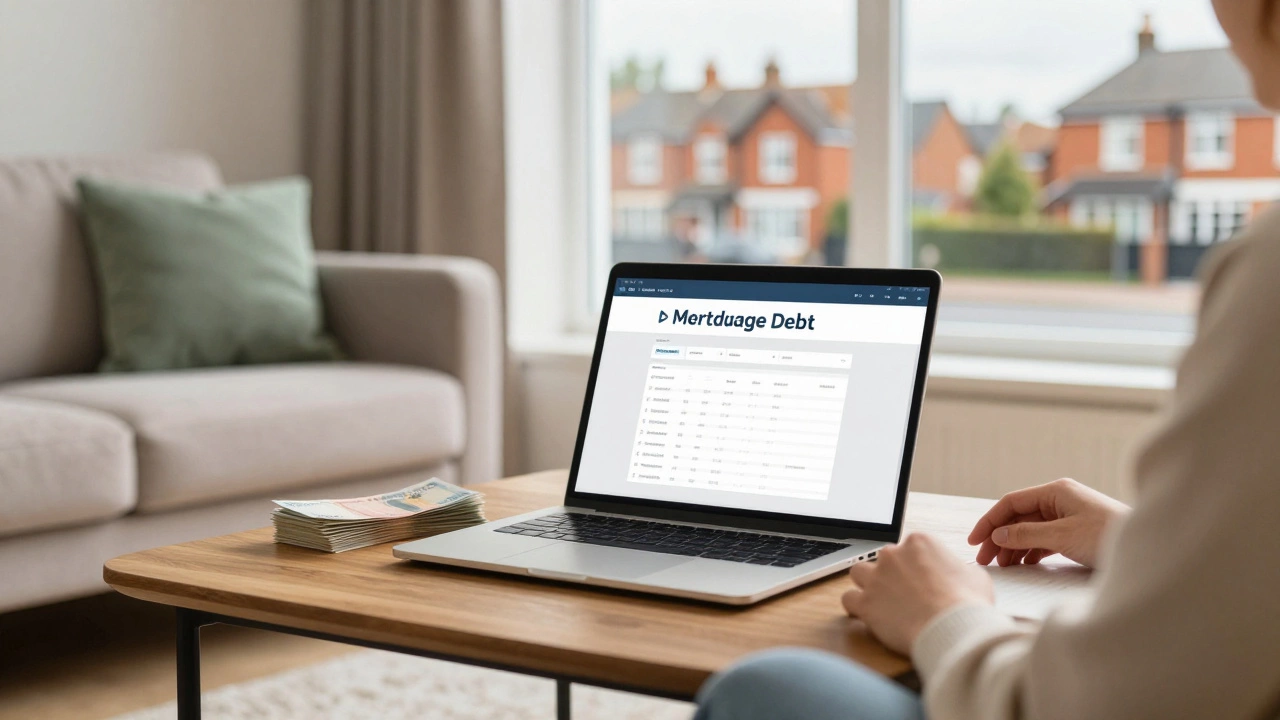
Remortgage Principal Reduction Calculator
Current Situation & Inputs
Analysis Results
Dropping below 60% LTV often qualifies you for lower interest rates. You are now in a safer equity position.
You’ve been paying down your mortgage for years. Maybe you got a pay rise, sold a car, or finally cleared that credit card debt. Now, you’re looking at your monthly statement and thinking: "Why am I still owing so much?" You want to lower the principal balance of your mortgage is a loan specifically used to purchase real estate property right now, not just wait until it naturally pays off in thirty years.
The short answer is yes. You can absolutely remortgage to borrow less than you currently owe. In fact, this is one of the smartest moves you can make if your goal is to become debt-free faster or stop paying interest on money you no longer need. But lenders don’t always make this process obvious because they lose out on interest income when you shrink their loan.
What Does It Mean to Borrow Less?
When people talk about borrowing less during a remortgage, they usually mean two different things. Understanding the difference is crucial because the paperwork and impact on your finances vary significantly.
First, there is the principal reduction. This means you take cash from your savings or an inheritance and use it to pay down the existing loan balance before closing the new deal. If you owe $300,000 and you have $50,000 in savings, you might choose to pay off that $50,000 upfront. Your new mortgage would then be for $250,000. This lowers your Loan-to-Value (LTV) ratio immediately.
Second, there is the term compression. Sometimes, people say they want to "borrow less" when they actually mean they want to shorten the time they are borrowing for. For example, moving from a 30-year term to a 15-year term. While the total amount borrowed remains the same initially, the monthly obligation changes drastically, and the total interest paid over the life of the loan drops sharply.
In this guide, we focus on the first scenario: actively reducing the outstanding capital balance through a remortgage transaction.
Why Would You Want to Do This?
Most borrowers remortgage to get a lower interest rate or to pull equity out for renovations. Reducing the principal seems counterintuitive if you have cash sitting in a high-interest savings account. However, there are compelling reasons to slash your debt early.
- Risk Mitigation: If you live in Brisbane or any major Australian city, property values fluctuate. By lowering your LTV ratio, you build a larger buffer against market downturns. If the market dips 10%, you won’t fall into negative equity.
- Psychological Freedom: Carrying less debt reduces financial stress. Knowing you own more of your home outright provides peace of mind that a higher interest return on savings cannot match.
- Simplifying Finances: If you have multiple debts-a home loan, a personal loan, and credit cards-consolidating them into a smaller, single mortgage payment can streamline your budgeting.
- Tax Efficiency: In some jurisdictions, while mortgage interest may not be tax-deductible for owner-occupied homes, having less debt means less non-deductible expense dragging on your net worth.
The Mechanics: How to Execute a Principal Reduction
Lenders are generally happy to accept a lower loan amount, but the process requires careful timing. You cannot simply tell your bank, "I want my loan to be $100k less," and have them adjust the ledger without a formal refinancing event.
- Calculate Your New LTV: Determine your current property value and subtract your desired new loan amount. For example, if your home is worth $600,000 and you want a new loan of $200,000, your LTV is 33%. This puts you in the lowest risk category for lenders.
- Gather Proof of Funds: You must show the lender where the money to pay down the principal is coming from. This could be a savings account statement, evidence of a gift from family, or proceeds from the sale of another asset.
- Apply for the New Mortgage: Submit a standard remortgage application. Clearly state in the application that you intend to bring cash to settlement to reduce the principal balance. Some online forms have a specific field for "Cash to Settlement" or "Additional Repayment at Closing."
- Settlement Day Adjustment: On the day the new loan closes, the funds flow as follows: The new lender pays off the old lender in full. Then, you pay the remaining balance of the new loan amount using your cash reserves. The result is a new loan contract with a lower principal.

Impact on Interest Rates and Fees
Here is the good news: A lower LTV often qualifies you for better interest rates. Lenders view borrowers with low LTVs (below 80%) as safer bets. In the current 2026 market, where rates have stabilized after the volatility of previous years, dropping from an 80% LTV to a 60% LTV might save you several basis points on your annual percentage rate (APR).
However, you must weigh these savings against the costs of remortgaging. These include:
- Application Fees: Administrative costs charged by the new lender.
- Valuation Fees: Cost to appraise your home’s current market value.
- Legal Costs: Conveyancing fees to transfer the title and discharge the old mortgage.
- Exit Fees: Potential penalties from your current lender if you are breaking a fixed-rate deal early.
If the interest rate saving is minimal, the upfront costs might outweigh the benefit of a slightly lower principal. Always run the numbers. A general rule of thumb is that the annual interest savings should exceed the total closing costs within 18 to 24 months.
| Strategy | Goal | Impact on Monthly Payment | Best For |
|---|---|---|---|
| Principal Reduction | Lower total debt | Decreases significantly | Debt aversion, risk mitigation |
| Term Compression | Pay off faster | Increases | Maximizing equity build |
| Rate Shopping | Lower interest cost | Decreases slightly | Cash flow improvement |
Common Pitfalls to Avoid
One mistake people make is draining their emergency fund to reduce their mortgage. While a lower mortgage balance looks great on paper, having zero liquid cash is dangerous. Life happens-cars break down, medical issues arise. Keep at least three to six months of living expenses in a high-yield savings account before touching your mortgage principal.
Another pitfall is ignoring the opportunity cost. If your mortgage rate is 4.5% but you can earn 5.5% in a guaranteed government bond or a high-interest savings account, financially speaking, you lose money by paying down the mortgage early. Only do this if the psychological benefit of being debt-free outweighs the mathematical loss, or if your mortgage rate is significantly higher than your investment returns.

Alternatives to Formal Remortgaging
If the hassle of refinancing feels too high, consider these alternatives:
Offset Accounts: Many Australian banks offer offset accounts linked to your mortgage. If you keep your extra cash in this account, it offsets the daily interest calculation. You don’t formally reduce the principal, but you pay less interest, effectively achieving a similar outcome without the legal fees of a remortgage.
Extra Repayments: Most variable rate mortgages allow unlimited extra repayments. You can simply log into your banking app and make a lump-sum payment toward the principal. This reduces your balance immediately and recalculates your amortization schedule, shortening the loan term without needing a new contract.
Final Thoughts on Borrowing Less
Borrowing less when you remortgage is a powerful tool for taking control of your financial future. It transforms your home from a liability-heavy asset into a solid foundation of wealth. Whether you are driven by fear of market crashes or the simple desire to own your home outright sooner, the path is clear. Just ensure you keep enough liquidity for emergencies and calculate whether the interest savings justify the closing costs.
Will borrowing less affect my credit score?
Generally, no. Paying down debt improves your debt-to-income ratio, which is positive. However, applying for a new mortgage involves a hard inquiry, which may temporarily dip your score by a few points. Over time, the reduced utilization will help your score recover and improve.
Can I borrow less if I have a fixed-rate mortgage?
Yes, but you may face breakage fees. Fixed-rate deals often include penalties for exiting early. You need to calculate if the long-term savings from a lower principal and potentially lower rate outweigh the immediate penalty fee.
Do I need a solicitor to reduce my mortgage principal?
If you are doing a full remortgage with a new lender, yes, you will need conveyancing services to discharge the old mortgage and register the new one. If you are simply making an extra repayment on your existing loan, no solicitor is needed; you can do it directly through your bank.
Is it better to pay off the mortgage or invest the money?
This depends on the interest rate differential. If your mortgage interest rate is higher than the guaranteed return you can get from investments, paying off the mortgage is the smarter move. If investment returns are higher, investing may yield greater wealth, provided you are comfortable with the risk.
How much can I typically reduce my loan by?
There is no strict limit other than what you have in cash and what the lender allows. You can reduce the loan by any amount, even paying it off entirely. However, lenders may require a minimum loan amount (e.g., $10,000) to keep the account active.