
Budget 3R Savings Calculator
How much could you save?
See how much you could save by reducing non-essential expenses and reallocate funds toward your goals.
Reduce Non-Essential Expenses
Your Savings Potential
Monthly Savings
$0.00
Potential monthly savings from reducing expenses
Annual Savings
$0.00
What you could save in a year
Recommended Reallocation
Based on your savings, consider allocating:
$50 to emergency fund
$40 to debt repayment
$30 to personal goals
Real example: A teacher saved $140/month by reducing takeaways, and a delivery driver saved $70 by smarter fueling.
Remember: The goal isn't restriction. It's alignment with what truly matters to you.
How This Works
Follow these 3 R's to build your own budget success:
-
1Record: Track your spending for 30 days to see where money actually goes.
-
2Reduce: Cut back on non-essential expenses that don't add value to your life.
-
3Reallocate: Move the money you saved to meaningful goals like debt repayment or savings.
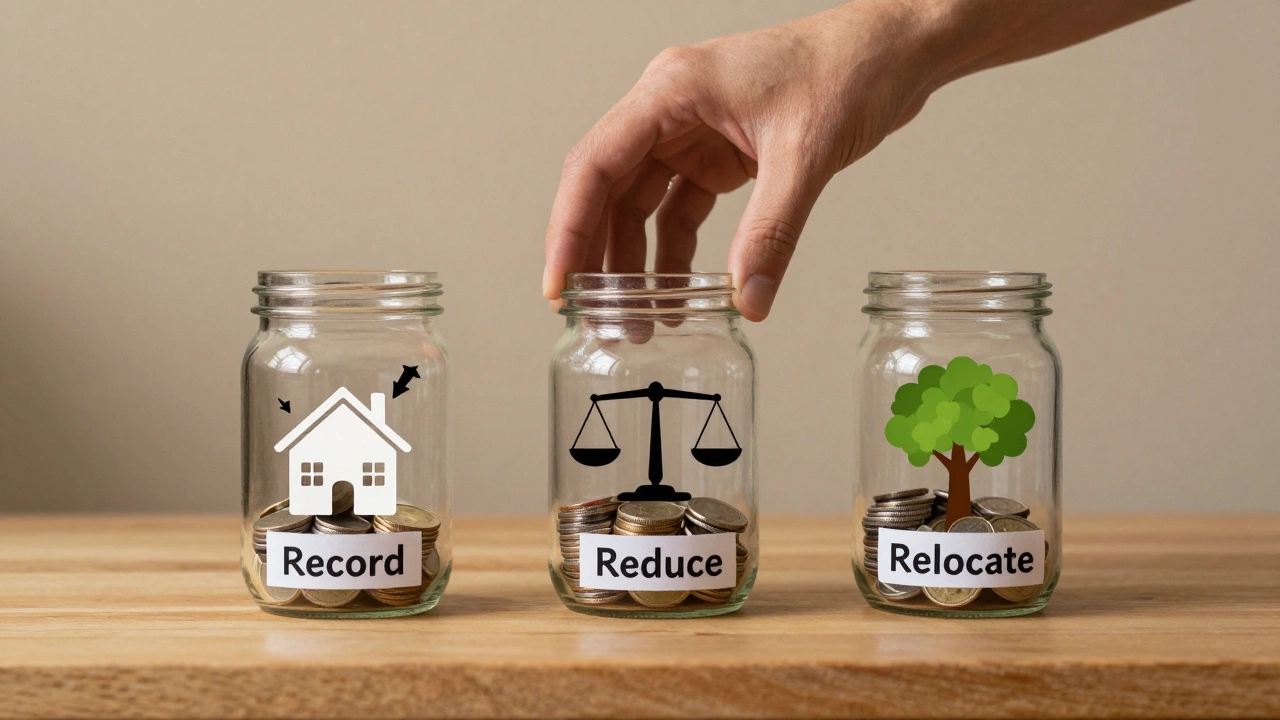
Most people think budgeting is about cutting out coffee and skipping meals. But that’s not how real budgets work. A good budget isn’t about restriction-it’s about control. And the key to that control? The 3 R’s: Record, Reduce, and Reallocate. These aren’t fancy financial terms. They’re simple, practical steps that people who actually stick to budgets use every single month.
Record: Know Where Your Money Actually Goes
You can’t fix what you don’t measure. That’s the first rule. Most people guess how much they spend. They think they spend $300 on food, but when they check their bank statements, it’s $520. That gap? That’s where budgets break.
Start by tracking every dollar for 30 days. Not just the big stuff-coffee, snacks, subscriptions, that $7 Uber ride to the corner store. Use your bank app, a free app like Mint or YNAB, or even a notebook. Write it down as you spend it. No exceptions.
After a month, you’ll see patterns. Maybe you’re paying for three streaming services you never watch. Or you’re buying lunch five days a week because you didn’t pack anything. That’s not weakness. That’s data. And data is power.
Here’s what real people found in Brisbane:
- One teacher tracked her spending and realized she spent $180/month on takeaways after work. She started cooking on Sundays and cut that to $40.
- A delivery driver noticed he was spending $120/month on fuel top-ups because he never filled up at cheaper stations. He started planning his refills and saved $70 a month.
Recording isn’t about being perfect. It’s about being honest. Once you know where your money is going, you’re no longer flying blind.
Reduce: Cut the Noise, Keep the Value
Not every expense is worth keeping. But reducing doesn’t mean living like a monk. It means asking: Does this add real value to my life?
Look at your top 5 spending categories from your tracking. Find one thing you can cut or cut back on. It doesn’t have to be huge. A $15/month gym membership you never use? Cancel it. A $12 subscription to a podcast app you only listen to once a week? Switch to free options. A $50 monthly phone plan with unused data? Downgrade.
People who stick to budgets don’t cut everything. They cut the stuff they don’t care about. That frees up money for the things they do care about.
For example:
- A student in South Brisbane switched from a $90/month mobile plan to a $35 prepaid plan with enough data for calls and maps. She used the extra $55 to build a small emergency fund.
- A couple realized they were paying $110/month for cable TV. They canceled it, got a $12/month streaming service, and bought a $40 secondhand projector. Their entertainment experience improved, and they saved $80 a month.
Reduction isn’t about sacrifice. It’s about alignment. If you’re spending money on something that doesn’t bring you joy or solve a real problem, it’s not a need-it’s noise.
Reallocate: Move Money to What Matters
This is where most budgets fail. People cut back but don’t move the money anywhere meaningful. They just leave it in their account, thinking they’re "saving." But without a plan, that money gets eaten by impulse buys or just disappears.
Reallocating means taking the money you saved from reducing and giving it a job. That job could be:
- Building a $500 emergency fund
- Putting $100 a month into a high-interest savings account
- Paying off a credit card with 20% interest
- Setting aside $75 for a yearly car service
Here’s how it works in practice:
Let’s say you saved $150 this month by cutting unused subscriptions and eating out less. Instead of letting that $150 sit there, you move it:
- $50 to your emergency fund
- $50 to your credit card payment
- $50 to a "fun money" category for a movie night or new book
Why include fun money? Because budgets that don’t allow joy don’t last. Reallocating isn’t just about debt or savings-it’s about balance. You’re not just controlling money. You’re designing a life you want to live.
One mother in Toowoomba used this method to pay off $4,000 in credit card debt in 11 months. She didn’t get a raise. She didn’t win the lottery. She just moved $365 a month from "wasted" spending into her card payment. She also kept a $50 "treat fund" each month so she didn’t feel deprived.

Why the 3 R’s Work Better Than Traditional Budgets
Traditional budgets often fail because they’re rigid. They say: "You can only spend $200 on groceries." But what if your kid gets sick and you need extra food? What if your car needs a repair? That budget breaks.
The 3 R’s are flexible. They don’t tell you what to spend. They teach you how to think about spending.
Record gives you clarity. Reduce gives you freedom. Reallocate gives you purpose.
People who use this method don’t feel like they’re on a diet. They feel like they’re in charge. And that changes everything.
Common Mistakes People Make
Even with the 3 R’s, people slip up. Here are the three biggest mistakes:
- Waiting until the end of the month to record spending. Memory is unreliable. Track daily.
- Trying to reduce everything at once. Pick one thing. Master it. Then move to the next.
- Not reallocating the savings. If you don’t give the money a job, it’ll find a way to disappear.
Also, don’t compare your progress to someone else’s. Your budget is yours. If your friend pays off debt fast, that’s great. But if your goal is to build savings first, that’s just as valid.
What Happens After You Master the 3 R’s
Once you’ve done this for 3-6 months, something changes. You stop thinking about money as a source of stress. You start thinking of it as a tool.
You’ll notice you’re less anxious about unexpected bills. You’ll say "no" to things you don’t want without guilt. You’ll start planning ahead-like saving for a holiday, a new phone, or even a small investment.
That’s the real win. Not the numbers in your account. It’s the peace of mind.
Are the 3 R’s only for people with low income?
No. The 3 R’s work for any income level. Someone earning $80,000 a year might record $1,200 in monthly subscriptions. Someone earning $40,000 might record $300 in impulse buys. The principle is the same: know where your money goes, cut what doesn’t serve you, and move the rest to something meaningful.
Do I need an app to track my spending?
No. You can use a notebook, a spreadsheet, or even your bank’s transaction list. Apps make it easier, but they’re not required. The key is consistency-not the tool.
How long does it take to see results?
You’ll start seeing changes in 30 days. You’ll notice where you’re overspending. In 90 days, you’ll have real money freed up. In six months, you’ll have a habit that changes how you think about money for life.
What if I miss a day of tracking?
Miss a day? That’s fine. Just pick up where you left off. Perfection isn’t the goal. Awareness is. One week of perfect tracking followed by two weeks of no tracking is less useful than 10 weeks of mostly tracking with a few missed days.
Can I use the 3 R’s if I have debt?
Yes. In fact, the 3 R’s are perfect for debt. Record your spending to see where you’re leaking money. Reduce the non-essentials. Reallocate that money toward paying off debt faster. Many people pay off credit cards in under a year using this method-even on modest incomes.
Next Steps: Start Today
You don’t need a perfect plan. You don’t need to wait for payday. Start right now.
- Open your bank app or pull out your last 30 days of statements.
- Write down every single expense. No judgment. Just record.
- At the end of the week, look for one thing you can reduce.
- Decide where you’ll move that saved money.
That’s it. No apps required. No financial advisor needed. Just you, your money, and three simple rules that have worked for millions.