

$20,000 Home Equity Loan Calculator
Your Estimated Results
Monthly Payment
Total Principal
Total Interest
Total Cost of Loan
You want to know exactly what hitting that "borrow" button for home equity loan means for your monthly budget. You are looking at a specific number: a lump-sum loan secured by the value of your home. The short answer? It depends entirely on the interest rate you get and how long you have to pay it back. But if we look at current market conditions in 2026, you can expect a monthly payment somewhere between $350 and $450 for a standard five-year term.
That range might feel vague, so let’s break down why your payment could be lower or higher than those numbers. We will look at real-world scenarios, compare fixed loans against lines of credit, and help you decide if taking out this cash is actually worth the risk to your property.
The Math Behind Your Monthly Payment
To understand your payment, you need to look at three variables: the principal amount ($20,000), the annual percentage rate (APR), and the loan term. Banks don’t just charge you for the money; they charge for the time you hold it.
In 2026, average interest rates for home equity products have stabilized compared to the volatility of previous years. A borrower with excellent credit-think a FICO score above 760-and a low debt-to-income ratio might secure a rate around 7.5%. Someone with fair credit might see rates climb to 9% or even 10%.
| Interest Rate (APR) | 5-Year Term | 10-Year Term | 15-Year Term |
|---|---|---|---|
| 7.5% | $402 | $237 | $183 |
| 8.5% | $409 | $244 | $191 |
| 9.5% | $416 | $251 | $200 |
| 10.5% | $423 | $259 | $209 |
Notice how stretching the loan from five years to ten cuts the monthly payment almost in half. That sounds great for your cash flow, but it doubles the total interest you pay over the life of the loan. With a 7.5% rate, a five-year loan costs you about $4,100 in total interest. A ten-year loan at the same rate costs you nearly $8,400. You are trading monthly comfort for long-term expense.
Fixed Loan vs. Home Equity Line of Credit (HELOC)
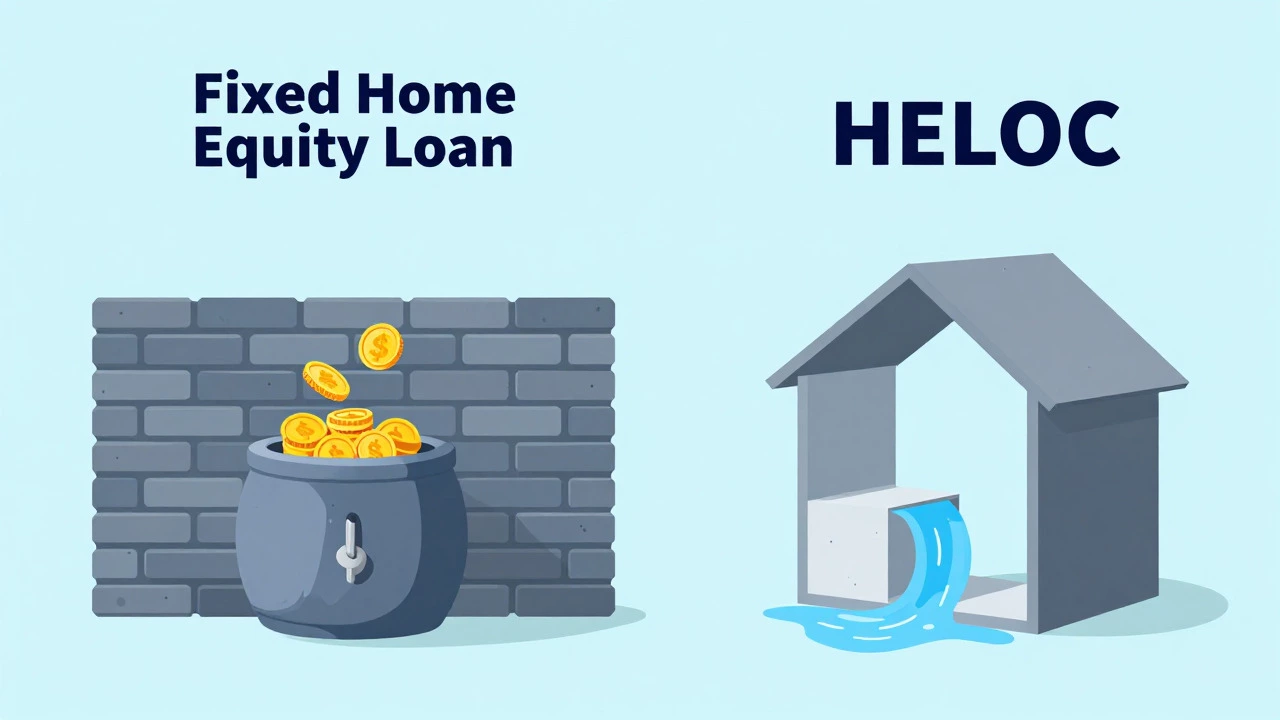
Before you sign anything, you need to distinguish between a home equity loan and a HELOC. They both use your house as collateral, but they work differently.
A home equity loan gives you the full $20,000 upfront. Your payment stays the same every month. This predictability makes it easier to budget for large, one-time expenses like kitchen renovations or medical bills.
A Home Equity Line of Credit is more like a credit card. You get a limit, say $20,000, but you only pay interest on what you actually borrow. During the draw period (usually 10 years), you might only make minimum interest-only payments. If you borrow $20,000 at 8%, your monthly payment during the draw period would be just $133. However, once the repayment phase starts, those payments jump significantly because you haven't been paying down the principal.
If you know exactly how much you need and want to pay it off quickly, the fixed loan is usually safer. If you have ongoing expenses, like tuition payments over several years, a HELOC offers flexibility.
Hidden Costs That Increase Your Effective Payment
Your monthly principal and interest payment isn’t the only cost. Lenders often attach fees that can add hundreds or even thousands of dollars to the deal. These don’t always show up in the first few pages of the disclosure statement.
- Origination Fees: Some lenders charge 1% to 2% of the loan amount. On $20,000, that’s $200 to $400 added to your closing costs.
- Appraisal Fees: Since your home is collateral, the bank needs to verify its current value. Expect to pay $300 to $500 for an independent appraisal.
- Title Search and Insurance: Ensuring there are no other liens on your property costs between $200 and $400.
- Recording Fees: Local government charges to record the lien against your property deed, typically $50 to $100.
While these are usually paid at closing, some lenders allow you to roll them into the loan balance. If you roll a $1,000 fee into your $20,000 loan, you are now borrowing $21,000. At 8% over five years, that extra $1,000 increases your monthly payment by roughly $20 and adds another $200 in total interest.
Tax Implications: Is Your Interest Deductible?
One major reason people choose home equity loans over personal loans is the potential tax benefit. In the United States, the Tax Cuts and Jobs Act changed the rules. You can generally deduct the interest on a home equity loan only if the funds are used to "buy, build, or substantially improve" the property that secures the loan.
If you take that $20,000 to fix your roof or add a deck, the interest is likely deductible (up to $100,000 of combined mortgage debt). If you use it to consolidate credit card debt or pay for a vacation, the interest is not deductible. Always consult a tax professional, but keep this distinction in mind when calculating your true cost.

Who Qualifies for the Best Rates?
Lenders look at four main factors to determine your rate and whether you get approved at all:
- Credit Score: Most lenders require a minimum score of 620, but scores above 740 unlock the lowest APRs.
- Loan-to-Value Ratio (LTV): This measures how much of your home you own outright. If your home is worth $300,000 and you owe $200,000 on your primary mortgage, your LTV is 66%. Adding a $20,000 loan brings it to 72%. Most lenders cap total LTV at 80% to 85%.
- Debt-to-Income Ratio (DTI): Your total monthly debt payments divided by your gross monthly income. Keeping this below 43% is crucial for approval.
- Equity Amount: You need enough equity to cover the loan plus closing costs. For a $20,000 loan, having at least $30,000 in available equity is a safe buffer.
If your credit has taken a hit recently, consider waiting. Improving your score by just 20 points can drop your rate by 0.25% to 0.5%, saving you hundreds over the life of the loan.
Alternatives to Consider Before Signing
Is a home equity loan the right tool? Not always. Here are two common alternatives:
Personal Loans: Unsecured loans don’t put your house at risk. Rates are higher, often 10% to 15% for good credit, but the process is faster and requires no appraisal. For a small amount like $20,000, the convenience might outweigh the slightly higher interest.
Cash-Out Refinance: If your current mortgage rate is high, refinancing your entire mortgage to a lower rate while pulling out $20,000 in cash might save you money overall. However, this resets your clock on your original mortgage term and comes with significant closing costs, making it less ideal for smaller amounts.
How long does it take to get a $20,000 home equity loan?
Typically, it takes 30 to 45 days from application to funding. This includes time for the appraisal, title search, and underwriting. If you need money urgently, a personal loan or HELOC might be faster, sometimes funding within a week.
Can I pay off my home equity loan early without penalties?
Most home equity loans do not have prepayment penalties, meaning you can pay it off early to save on interest. However, always check the fine print. Some older contracts or specific lender promotions may include a penalty if paid off within the first three years.
What happens if I miss a payment on my home equity loan?
Since your home is collateral, missing payments puts your property at risk of foreclosure. Lenders usually offer a grace period of 15 to 30 days before charging late fees. After several missed payments, they may initiate foreclosure proceedings. Contact your lender immediately if you struggle to pay; they may offer forbearance options.
Is a $20,000 home equity loan worth the closing costs?
If closing costs run $1,500 and you pay the loan off in five years, you need to ensure the interest savings or financial benefit of the loan exceeds that $1,500. For small amounts, the transaction costs can eat into the benefits. Compare the total cost of the home equity loan against a personal loan with zero closing costs.
Do I need a co-signer for a $20,000 home equity loan?
Usually, no. As long as you have sufficient equity, a decent credit score, and stable income, you can qualify on your own. A co-signer is typically only needed if your income is insufficient to cover the new debt payment or if your credit history is very thin.