

FAFSA Eligibility Calculator
Your Potential Aid
When you hear someone say, "My family makes $70,000 a year-will we even qualify for FAFSA?" it sounds like they’re asking if they’re too rich for help. But here’s the truth: FAFSA isn’t about being poor. It’s about need. And $70,000 isn’t too much-it’s actually pretty common.
FAFSA Doesn’t Have an Income Cutoff
One of the biggest myths about FAFSA is that if your family makes over a certain amount, you’re automatically disqualified. That’s not true. There’s no official income limit. Even families making $200,000 or more can get aid-just not always grants. The system doesn’t look at your income alone. It looks at your whole financial picture: how many kids are in college, how much you’ve saved, how many people live in your home, even your state’s cost of living.
For example, if you’re a single parent with two kids in college and you make $70,000, you might qualify for more aid than a two-parent household making $80,000 with one kid. Why? Because the formula spreads your income across more students. The Expected Family Contribution (EFC) is calculated using a complex formula that considers assets, expenses, and family size-not just your paycheck.
What $70,000 Actually Looks Like
Let’s say you live in Ohio. $70,000 a year sounds solid. But if you’re supporting a family of four, paying rent, car insurance, medical bills, and groceries, that money disappears fast. The federal poverty guideline for a family of four in 2026 is around $31,000. So $70,000 is more than double that-but it doesn’t mean you’re wealthy. It means you’re middle class. And middle-class families are the ones who get squeezed hardest by college costs.
Public universities in many states cost $15,000-$20,000 a year just for tuition. Add room, books, and transportation, and you’re looking at $25,000+. If you’re paying that out of pocket, $70,000 doesn’t go far. That’s why so many families at this income level still rely on federal aid.
What Kind of Aid Can You Get?
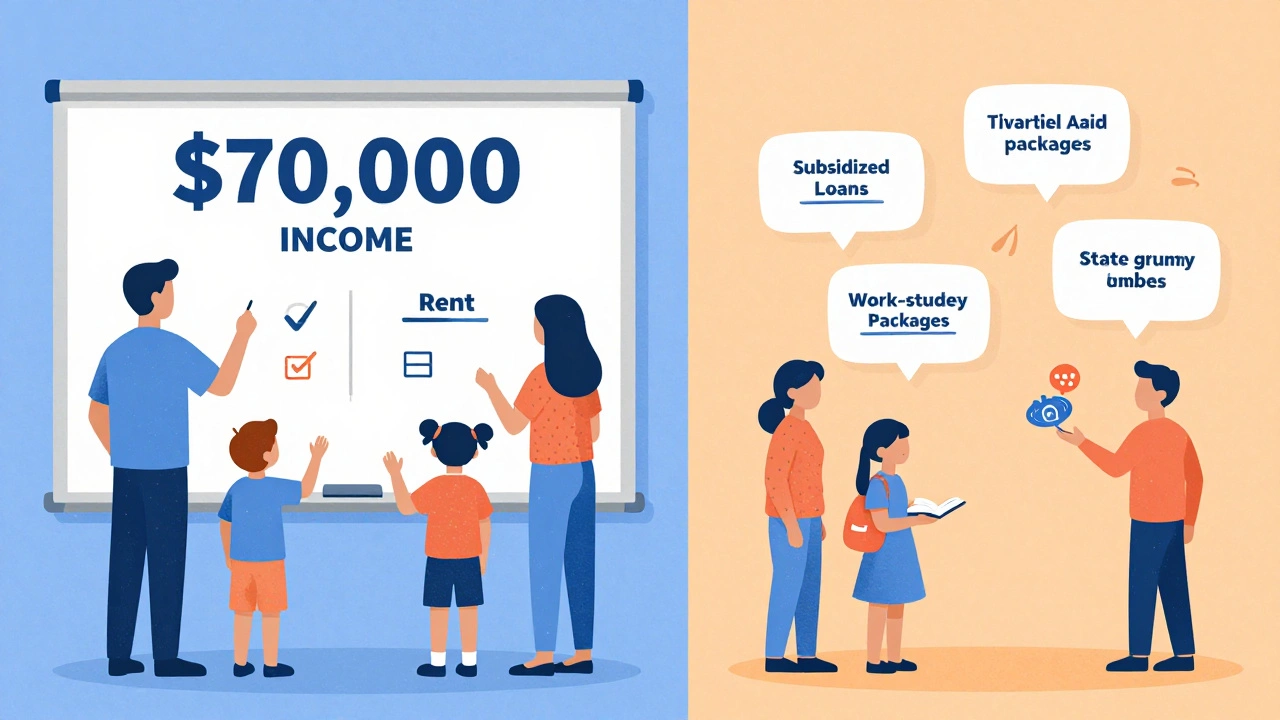
At $70,000, you’re unlikely to get a Pell Grant-that’s mostly for families under $65,000. But you can still get other types of aid:
- Subsidized Stafford Loans: The government pays the interest while you’re in school. You qualify based on financial need.
- Unsubsidized Stafford Loans: Available to everyone, regardless of income. You’ll owe the interest from day one.
- Work-Study: Part-time jobs on campus. Need-based, but many families at $70,000 qualify.
- State Grants: Some states offer aid even if you don’t qualify for federal grants. Check your state’s website.
- Merit Aid: Scholarships based on grades, not income. These aren’t tied to FAFSA but you still need to file it to be eligible for other aid.
According to the U.S. Department of Education, over 60% of students who file FAFSA get some kind of aid-even if their parents make over $75,000. That’s not a small number. That’s millions of families.
Why Filing FAFSA Is Non-Negotiable
Even if you think you’re "too rich," file FAFSA anyway. Why? Because:
- Many colleges use FAFSA data to award their own scholarships.
- You can’t get federal student loans without filing.
- Some private lenders require FAFSA completion to approve loans.
- Work-study positions are only available to those who file.
- State aid deadlines often come before college scholarship deadlines.
There’s zero downside to filing. No penalty. No form that says, "You made too much, go away." It’s just a form. Takes 30 minutes. Free to submit. And if you skip it, you’re leaving money on the table-even if you don’t realize it.
What About Asset Limits?
Income isn’t the only thing that matters. Your savings count too. The FAFSA formula counts 5.64% of parental assets as available for college each year. So if you have $50,000 in a savings account, $2,820 gets counted toward your expected contribution. That might seem small, but if your EFC is already close to the cost of school, that extra $2,820 could mean losing a few hundred dollars in aid.
That’s why some families move money into retirement accounts (which aren’t counted) or pay off debt before filing. It’s not about hiding money-it’s about optimizing what’s reported. But don’t panic. $70,000 in income with $10,000 in savings? You’re still very likely to get aid.
Real-Life Example: The Smith Family
Let’s say the Smiths make $72,000. They live in Michigan. They have two kids: one in community college, one starting a four-year university. They have $8,000 in savings, a car worth $12,000, and no home equity. They file FAFSA.
Result? The older kid gets a $6,500 Pell Grant. The younger kid doesn’t qualify for Pell, but gets $5,500 in subsidized loans, $3,000 in unsubsidized loans, and a $1,500 state grant. Plus, they’re approved for work-study. Total aid: $16,500. The family still pays about $10,000 out of pocket-but that’s far less than the $25,000 they’d have paid without aid.
That’s not a failure. That’s smart planning.

Common Mistakes People Make
People at $70,000 often think:
- "I don’t need aid because I can pay." → But can you? And what about emergencies? Medical bills? Job loss?
- "My kid won’t get anything." → You don’t know until you file.
- "I’ll wait until next year." → Aid deadlines are strict. Miss one, and you wait a full year.
- "I don’t have time." → It takes 30 minutes. Use the IRS Data Retrieval Tool. It auto-fills most of it.
And here’s the kicker: if you don’t file FAFSA, you also lose access to federal loan forgiveness programs down the road. Even if you think you’ll pay everything off yourself, life doesn’t always go as planned.
What If You’re Denied?
Some families get a letter saying their EFC is too high. That doesn’t mean no aid. It just means no need-based grants. You can still get unsubsidized loans. You can still apply for scholarships. You can still talk to the financial aid office at the school. Many schools have emergency funds, tuition discounts, or payment plans. Don’t take "no" from the system. Ask again.
Some schools even let you appeal your aid package if your income dropped after you filed. If you lost a job, had medical bills, or had a divorce, submit a letter. They’ll reconsider.
Bottom Line
$70,000 isn’t too much for FAFSA. It’s exactly the kind of income that makes you eligible for meaningful help. You’re not too rich. You’re just not poor enough to get the full grant-but you’re still in the zone where loans, work-study, and state aid make a huge difference. Filing FAFSA isn’t a sign of desperation. It’s a smart financial move. It’s the difference between taking out $30,000 in private loans and $15,000 in federal ones. It’s the difference between paying $25,000 out of pocket and $10,000.
So if you’re making $70,000? File it. No excuses. The money’s there. You just have to ask for it.