

Retirement Payout Estimator
Quick Takeaways for Your Retirement Income
- Defined Benefit plans offer a guaranteed monthly check based on salary and years of service.
- Defined Contribution plans (like 401(k)s or Superannuation) depend on your investment balance and withdrawal rate.
- The '4% Rule' is a common benchmark for sustainable withdrawals from a personal pot.
- Taxes and inflation are the two biggest factors that shrink your actual spending power.
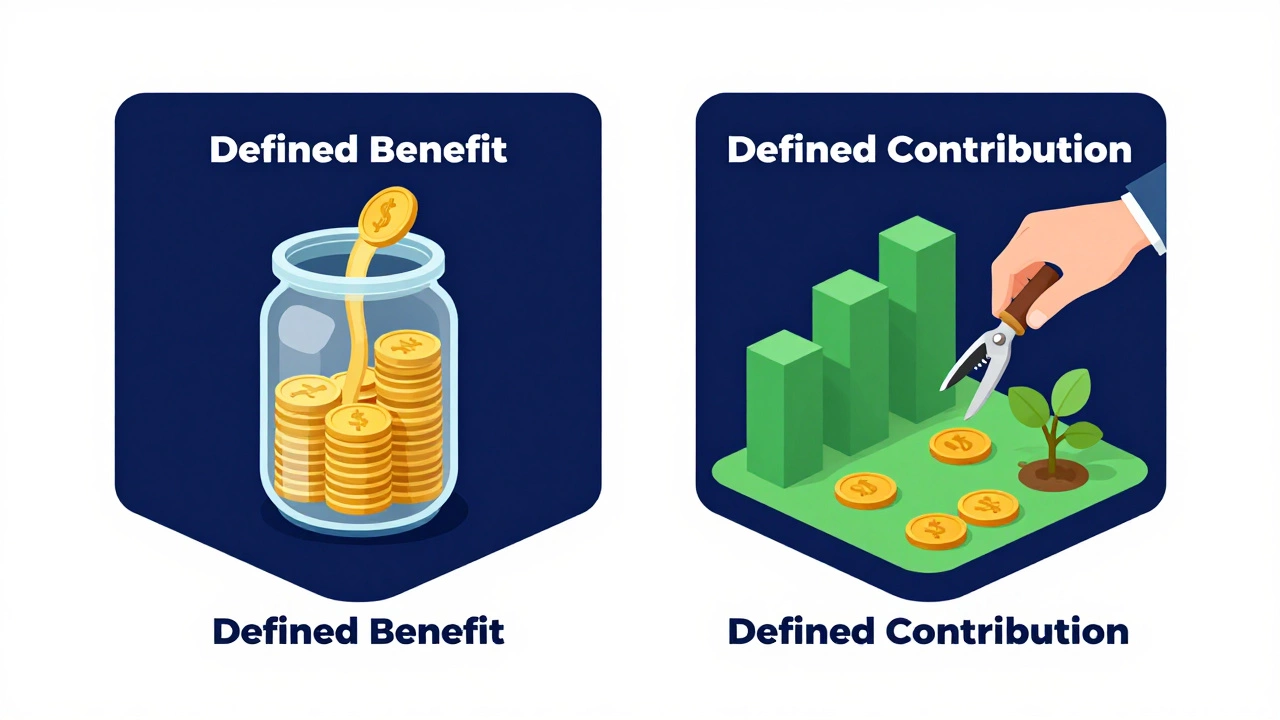
First, we need to clear up a massive point of confusion. When people ask what a 'typical' payout is, they are usually talking about one of two very different animals. Defined Benefit Pension is a retirement plan where an employer guarantees a specific monthly benefit for life, regardless of market performance. This is the "gold standard" often found in government jobs or old corporate contracts. On the other hand, you have Defined Contribution Plan, which is an account where the payout depends entirely on how much was contributed and how the investments performed. Most modern workers have the latter.
How Defined Benefit Payouts Are Calculated
If you're lucky enough to have a defined benefit plan, your payout isn't a guess; it's a formula. Most companies use a calculation like: (Years of Service) x (Average Salary) x (Multiplier). For example, if you worked for 20 years, your average final salary was $60,000, and the multiplier is 1.5%, your annual payout would be $18,000 per year.
But it's not always that simple. You might have to choose between a "Single Life Annuity" or a "Joint and Survivor Annuity." If you take the single life option, you get a bigger check, but the money stops the moment you pass away. If you choose the joint option, the payout is smaller, but your spouse continues to receive a check after you're gone. It's a trade-off between maximizing your own lifestyle and protecting your partner.
| Feature | Defined Benefit (DB) | Defined Contribution (DC) |
|---|---|---|
| Payout Predictability | High (Guaranteed check) | Variable (Market dependent) |
| Investment Risk | Employer carries the risk | Employee carries the risk |
| Payment Method | Monthly Annuity | Drawdowns or Lump Sum |
| Impact of Longevity | Payment lasts until death | Risk of outliving the money |
Decoding the Defined Contribution Payout
For those with a 401(k), IRA, or Australian Superannuation, the "payout" is whatever you decide to take out. This is where the 4% Rule comes in. This guideline suggests that if you withdraw 4% of your total portfolio in the first year of retirement and adjust for inflation every year after, your money should last roughly 30 years.
Let's look at a real-world scenario. If you've saved $500,000, a 4% withdrawal gives you $20,000 in your first year. If inflation is 3%, next year you'd take out $20,600. However, this isn't a law of nature. If the stock market crashes in the first two years of your retirement (what experts call "sequence of returns risk"), that 4% might actually be too aggressive, and you could deplete your fund faster than expected.
The Hidden Eaters: Taxes and Inflation
The number on your pension statement is rarely the number that lands in your pocket. Most pension payouts are treated as taxable income. If your payout is $4,000 a month, you might only see $3,200 after federal and state taxes. It's a common mistake to budget based on the gross amount and then realize they've underestimated their tax bracket.
Then there is inflation. If your pension doesn't have a COLA (Cost-of-Living Adjustment), your buying power drops every year. A $2,000 monthly check feels great today, but if inflation averages 3%, in ten years that same $2,000 will only buy what $1,485 buys today. This is why diversifying your income with Social Security or personal savings is vital.
Combining Multiple Income Streams
Rarely does a person rely on just one source. A typical retirement "paycheck" is actually a mosaic. You might have a small corporate pension, a government pension like Social Security, and a personal investment account.
The goal is to create a "floor" of guaranteed income that covers your basic needs-housing, food, and medicine-and then use your variable accounts for the "fun stuff" like travel or hobbies. For example, if your basic needs are $3,000 a month, and your fixed pensions provide $2,500, you only need to pull $500 from your investments. This drastically reduces the stress of a market downturn because your survival isn't tied to the S&P 500.

Common Payout Pitfalls to Avoid
One of the biggest mistakes people make is taking the "lump sum" payout instead of the monthly annuity. Companies love offering lump sums because it gets the liability off their books. While a $200,000 check looks tempting, it requires immense discipline to manage. Many people spend too much too fast or lose the money in a bad investment, whereas the annuity provides a guaranteed check for as long as they breathe.
Another trap is ignoring the "survivor benefit" implications. Some people opt for the highest possible monthly payment, ignoring the fact that if they die early, their spouse gets absolutely nothing from that pension. It's a gamble on your own mortality that can leave a partner in financial ruin.
Is it better to take a pension lump sum or monthly payments?
It depends on your health and financial discipline. Monthly payments provide a guaranteed income stream (longevity insurance), which is safer for most. A lump sum offers more control and the potential for higher growth if invested wisely, but it carries the risk that you might spend the money too quickly or lose it in the market.
What is the 4% rule in pension planning?
The 4% rule is a rule of thumb for defined contribution plans. It suggests withdrawing 4% of your total portfolio in the first year of retirement and adjusting that amount for inflation each year thereafter. This is designed to make your savings last for approximately 30 years.
Do pension payouts include inflation adjustments?
Not all of them. Government pensions often include a Cost-of-Living Adjustment (COLA), but many private sector pensions do not. If your pension lacks a COLA, your purchasing power will decrease over time as prices for goods and services rise.
How does a survivor benefit affect my monthly check?
A survivor benefit typically reduces your monthly payout. In exchange for a smaller check during your lifetime, the pension company guarantees that a percentage of that payment will continue to your beneficiary (usually a spouse) after you pass away.
Can I change my pension payout option after I start receiving it?
Generally, no. Once you select your payout option (e.g., Single Life vs. Joint and Survivor) and the payments begin, the decision is permanent. It is critical to review your options carefully before signing the final paperwork.
Next Steps for Your Planning
If you're still working, the first thing you should do is request a "Pension Benefit Statement." This is a document that tells you exactly what your projected monthly payout will be based on your current years of service. Don't rely on the company's general brochures; get the number specific to your employee ID.
If you're already retired, track your "Net vs Gross." List every single deduction-taxes, health insurance premiums, and loan repayments-to see what your true spendable income is. If you find that inflation is eating your check too quickly, consider shifting some of your personal savings into inflation-protected assets like TIPS or real estate to bridge the gap.