
Student Loan Forgiveness Eligibility Checker
Answer the questions below to identify which forgiveness paths may apply to you.
The question "who is getting student loan forgiveness" has shifted dramatically over the last few years. In 2024 and 2025, headlines were dominated by broad cancellation plans that ultimately faced legal hurdles. By June 2026, the landscape is different. The era of sweeping, universal debt wipes has settled into a more targeted approach. Now, forgiveness isn't about luck or political promises; it’s about meeting specific criteria under existing laws that have been clarified, expanded, or enforced through new regulations.
If you are holding onto student debt, you might feel left behind if you don’t fit the traditional molds of a teacher or a public servant. But the rules for student loan forgiveness have evolved to include borrowers who were misled by their schools, those who struggle with low incomes, and even some private sector workers under new pilot programs. Understanding exactly which bucket you fall into is the first step to potentially wiping out your balance.
The Borrower Defense to Repayment: The Biggest Wave of Forgiveness
When we look at who is actually receiving large-scale forgiveness checks right now, the biggest group consists of borrowers filing for Borrower Defense to Repayment, a federal program that allows students to stop paying loans if their school misled them about the quality of education, job placement rates, or financial aid options.. This isn't just for victims of notorious diploma mills like Corinthian Colleges or ITT Tech. The Department of Education has streamlined the process significantly since 2023.
In 2025, the agency finalized "automatic approvals" for certain categories of schools. If you attended a school that was found to have committed widespread fraud, you likely didn't even need to file a detailed application. Your loan servicer identified you based on enrollment dates and granted full discharge. This has resulted in billions of dollars in forgiven debt for hundreds of thousands of borrowers.
However, if your school isn't on the automatic list, you can still apply. The key is proving misrepresentation. Did your recruiter promise a specific salary range that turned out to be false? Did they claim accreditation that the school didn't have? You need documentation-emails, brochures, or recorded calls. The threshold for evidence has been lowered, making it easier for regular students to qualify, not just those with obvious cases of fraud.
| Misrepresentation Type | What You Need to Prove | Typical Evidence |
|---|---|---|
| Job Placement Rates | School claimed high employment but data shows otherwise | Recruiter emails, outdated brochures |
| Accreditation Status | School said degrees would transfer or lead to licensure | State licensing board rejection letters |
| Financial Aid Errors | School incorrectly calculated aid, increasing loan burden | Award letters vs. actual charges |
Public Service Loan Forgiveness (PSLF) Expansions
For decades, Public Service Loan Forgiveness (PSLF) was notoriously difficult to navigate, with many applicants rejected after making 120 payments due to technicalities. That changed with the Temporary PSLF Waiver extensions and permanent rule changes implemented in late 2024. Today, PSLF is one of the most reliable paths to forgiveness for eligible workers.
Who qualifies? You must work full-time for a government organization (at any level: federal, state, local, tribal) or a qualifying 501(c)(3) nonprofit. Crucially, the definition of "qualifying employer" has been broadened. Part-time employees working multiple jobs can combine hours to meet the full-time requirement. Additionally, past payments that were previously disqualified-such as those made under the old Income-Based Repayment plan instead of the newer SAVE plan-are now being counted retroactively thanks to administrative fixes.
If you’ve been working in public service for years and haven’t applied yet, check your status immediately. Many people are surprised to find they already have 120 qualifying months when they review their updated payment history. The Department of Education is actively reaching out to these borrowers to finalize their discharge.
Income-Driven Repayment (IDR) Accruals
This is the quiet giant of student loan relief. Under the revised Income-Driven Repayment (IDR) plans, particularly the SAVE plan, any remaining balance on your direct loans is forgiven after 20 years of qualifying payments. For undergraduate-only debt, that period shrinks to just 10 years. This applies to almost anyone with federal loans, regardless of their profession.
The game-changer here is how interest is handled. If your monthly payment doesn’t cover the accruing interest, the government covers the rest. This means your balance stops growing while you’re on the plan. For borrowers with small incomes relative to their debt, this effectively turns IDR into a forgiveness program within a decade or two. Millions of borrowers enrolled in SAVE during 2024 and 2025 are on track to receive this discharge without needing to prove hardship beyond their income tax returns.
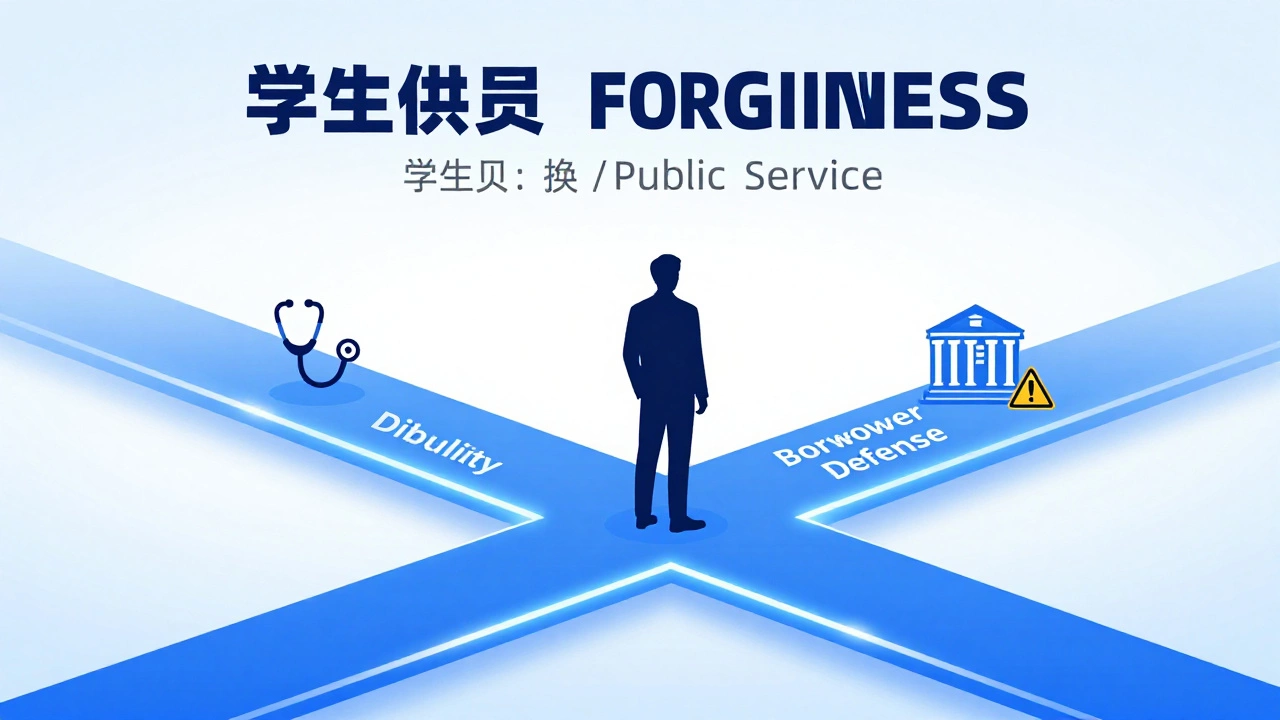
Total and Permanent Disability (TPD) Discharge
If you are unable to engage in any substantial gainful activity due to a physical or mental impairment, you may qualify for Total and Permanent Disability (TPD) Discharge. This isn't just for veterans; it applies to all federal borrowers. The approval process has become more accessible. You can get certified by a physician, or if you receive benefits from the Social Security Administration (SSA) or Veterans Affairs (VA), your discharge can be automatic.
In 2025, the SSA began sharing data directly with the Department of Education to identify eligible borrowers automatically. If you are receiving SSDI or SSI, you might have already been flagged for TPD discharge. Keep an eye on your loan servicer’s communications. Even if you aren’t on SSA benefits, a doctor’s certification form is straightforward and free to submit online.
Closed School Discharge
Did your school close while you were enrolled or shortly after you withdrew? If so, you likely qualify for Closed School Discharge. This applies even if you completed your degree, provided the school closed before you could reasonably complete your program or if the closure prevented you from completing it. The Department of Education maintains a list of eligible institutions. If your school is on that list, the discharge is often automatic. If not, you can petition by showing that you cannot complete a comparable program elsewhere.
Private Loans: The Hard Truth
It is critical to note that almost all forgiveness programs mentioned above apply only to federal student loans. Private student loans, issued by banks or credit unions, do not participate in PSLF, IDR forgiveness, or Borrower Defense. However, some private lenders offer limited hardship forbearance or death/disability discharges. If you have private loans, your best bet is often refinancing into a lower-rate product if your credit has improved, though this sacrifices federal protections. There is no broad "forgiveness" for private debt in the current 2026 landscape.
How to Check Your Eligibility Right Now
You don’t need to guess if you qualify. Here is a practical checklist to determine your next steps:
- Check your loan type: Log in to StudentAid.gov. If your loans say "Direct," "FFEL," or "Perkins," they are federal. FFEL and Perkins loans can often be consolidated into Direct Loans to make them eligible for forgiveness programs.
- Review your school’s status: Search the Department of Education’s database for Borrower Defense eligible schools. If yours is listed, apply immediately.
- Calculate your income-to-debt ratio: If your annual income is less than 1.5 times your total student debt, the SAVE plan will likely forgive your balance in 10-20 years with little to no monthly payments.
- Verify your employer: If you work for a nonprofit or government, submit a PSLF Employment Certification Form every year to ensure your payments are counting.
Common Pitfalls to Avoid
Be wary of third-party companies charging fees to help you apply for forgiveness. All federal forgiveness applications are free. These "debt relief" firms often take a cut of your savings or enroll you in unnecessary consolidation loans. Stick to official .gov websites. Also, don’t ignore letters from your servicer. Missing a deadline for automatic discharge verification can delay your forgiveness by months.
Is there any blanket student loan forgiveness happening in 2026?
No. Broad, universal forgiveness proposals have not been enacted into law. Current forgiveness is targeted toward specific groups such as those with borrower defense claims, public servants, disabled borrowers, and those on income-driven repayment plans.
Do I have to pay taxes on forgiven student loans?
Generally, no. The American Rescue Plan Act extended the tax-free status for discharged student loans until the end of 2025. As of 2026, most major forgiveness programs (PSLF, IDR, Borrower Defense, TPD) remain exempt from federal income tax. However, always consult a tax professional for your specific situation, especially regarding state taxes.
Can I get forgiveness if I went to a for-profit college?
Yes, this is a strong possibility. For-profit colleges are frequently scrutinized for misrepresentation. If your school made false claims about job prospects or accreditation, you can file a Borrower Defense to Repayment claim. Many former for-profit students have received automatic discharges in recent years.
How long does the forgiveness process take?
It varies. Automatic discharges (like some Borrower Defense or Closed School cases) can happen within weeks. Manual applications for PSLF or IDR forgiveness typically take several months to process. Borrower Defense claims with complex evidence can take 6-12 months. Patience is required, but payments are usually paused during processing.
Does consolidating my loans affect my forgiveness eligibility?
Consolidation is often necessary to make FFEL or Perkins loans eligible for IDR forgiveness or PSLF. However, if you are already on a Direct Loan, consolidation resets your progress toward PSLF unless you use the temporary waiver provisions. Always check your specific loan types before consolidating.