

Budget Pillars Calculator
Enter your estimated monthly figures for the five key budget pillars. This tool helps you visualize where your money goes and identifies potential structural issues in your finances.
You stare at your bank account balance on the 1st of the month. It looks healthy. Then, by the 20th, it’s gone. Sound familiar? Most people fail at budgeting not because they lack discipline, but because they start with the wrong data. They try to track every single coffee and coin flip from day one. That approach burns you out faster than a sprinter who tries to run a marathon without training.
The truth is simpler: you don’t need to know where every cent goes immediately. You just need to know where the big rocks land. If you can identify the five non-negotiable pillars of your financial life, you’ve already won half the battle. The rest is just detail work. Let’s cut through the noise and look at exactly what needs to hit that spreadsheet first.
Start with Fixed Obligations
Think of these as the walls of your house. They don’t move. Whether you buy groceries or skip dinner, these bills arrive whether you like them or not. In Australia, this usually means rent or mortgage repayments, utility bills (electricity, gas, water), and insurance premiums. According to the Australian Bureau of Statistics, housing costs often consume between 30% and 40% of household income for many families. If you ignore these numbers, your budget is fiction.
Don’t guess. Log into your bank portal and pull the last three months of statements. Average them out if they fluctuate slightly due to usage. But keep the core figure accurate. If your electricity bill spikes in winter, note the average annual cost divided by twelve. This prevents shock later. List these amounts clearly. If your total fixed obligations exceed 50% of your take-home pay, you have a structural problem, not a spending problem. You might need to downsize or refinance before you worry about entertainment costs.
Identify Essential Variable Costs
These are the things you need to survive, but the price tag changes based on your choices. Food, fuel, and public transport fall here. Unlike rent, you can control these variables. But you can’t eliminate them. Many beginners make the mistake of putting "Groceries" under "Wants." Big error. You eat every day. Therefore, food is an essential variable.
How do you estimate this? Track your spending for just two weeks. Don’t change your habits yet; just watch them. Did you spend $150 on groceries? Or was it $300? There’s a massive difference. For a single person in Brisbane, a realistic baseline for home-cooked meals might sit around $80-$100 per week. Add another $50-$70 if you rely on cars for commuting. Fuel prices fluctuate, so use the current national average as a placeholder, then adjust monthly. By separating essentials from wants early, you protect your basic quality of life while leaving room for flexibility.
Account for Debt Repayments
Debt is a silent budget killer. It doesn’t show up as a single line item called "Stress," but it eats away at your cash flow every month. You must list every debt repayment explicitly. This includes credit card minimums, car loans, personal loans, and HECS/HELP debts if you’re paying them voluntarily above the threshold.
Here’s a common trap: people only list the minimum payment. That’s fine for survival, but terrible for progress. When listing debt in your initial budget, write down the minimum required amount. This ensures you stay legal and avoid late fees. Once your budget stabilizes, you can add a separate line for "Extra Debt Payments." But for the first draft, stick to the mandatory outflow. If you have multiple cards, group them by interest rate rather than just name. High-interest debt (like credit cards at 18-20%) demands priority attention over low-interest loans (like mortgages at 6%). Seeing the total debt service ratio-the percentage of income going to debt-can be sobering. If it’s over 20%, you’re working hard for your creditors.
| Category | Type | Typical % of Income | Control Level |
|---|---|---|---|
| Housing (Rent/Mortgage) | Fixed | 30-40% | Low (Short Term) |
| Essentials (Food/Fuel) | Variable | 15-20% | Medium |
| Debt Repayments | Fixed | 10-20% | High (Long Term) |
| Savings/Emergency Fund | Variable | 10-15% | High |
| Discretionary Spending | Variable | Remaining | Very High |
Prioritize Savings as a Bill
This is the step most people skip until there’s money left over. Spoiler alert: there never is. Treat savings like a tax. It comes out before you see the rest. You need to list a specific amount for savings right next to your rent. Not "whatever’s left," but a hard number. Even if it’s just $50 a week.
Why does this matter? Because emergency funds prevent new debt. When your car breaks down, you don’t want to reach for the credit card. You want to reach for cash. Start with a small goal: $1,000. Once you hit that, aim for one month of living expenses. Listing this as a non-negotiable expense shifts your mindset. You aren’t saving what’s left; you’re spending on your future security first. Automate this transfer on payday. If you don’t see it, you won’t miss it. This psychological trick is more powerful than any spreadsheet formula.

Define Your Discretionary Allowance
Finally, you need a bucket for fun. Yes, really. A budget without fun is a prison sentence. If you restrict yourself too tightly, you’ll binge-spend by Friday night. Create a single line item for "Guilt-Free Spending." This covers dining out, subscriptions, hobbies, and impulse buys.
Calculate this by subtracting your fixed costs, essential variables, debt payments, and savings from your net income. Whatever remains is your allowance. If you have $200 left, that’s your cap for the month. Once it’s gone, it’s gone. No more movies until next month. This creates a clear boundary. It stops the guilt associated with buying a latte. You’ve already paid for it in your plan. Tracking this category loosely is fine. You don’t need to log every transaction, just the total. If you consistently blow past this limit, you either earn too little or your expectations are too high. Adjust accordingly.
Putting It All Together
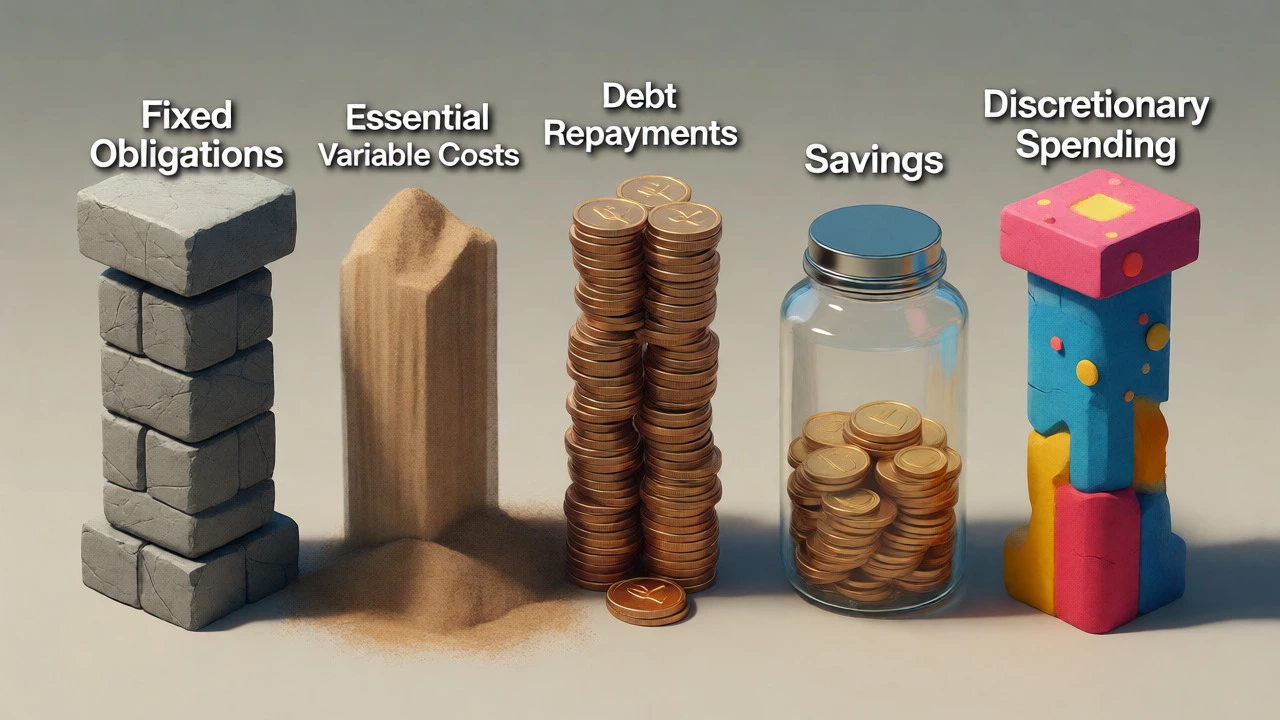
Now you have five clear categories: Fixed Obligations, Essential Variables, Debt Minimums, Savings, and Discretionary Allowance. This isn’t a complex accounting system. It’s a traffic light system. Green means go. Red means stop. Yellow means caution.
Review these five numbers once a month. Life changes. Rent increases. Fuel prices spike. Your salary might go up. Update the figures quarterly. Don’t obsess over daily fluctuations. Focus on the trends. Are your essential variables creeping up? Maybe you’re eating out more. Is your discretionary allowance always empty by the 15th? Maybe you need to lower it or increase your income.
Remember, the goal isn’t perfection. It’s awareness. You can’t manage what you don’t measure. But you don’t need to measure everything at once. Start with these five pillars. Build the foundation. Then, when you’re comfortable, you can drill down into details. But for now, keep it simple. Keep it real. And keep moving forward.
Should I include irregular expenses like car registration in my initial budget?
Not initially. These are best handled by setting aside a small monthly amount into a separate sinking fund. For example, if rego costs $600 annually, save $50 a month. List this $50 as a fixed obligation or a specific savings goal, rather than trying to predict the exact timing of the bill in your main monthly view.
What if my fixed costs exceed 50% of my income?
This indicates a structural issue. You likely need to reduce housing costs (downsize, get a roommate) or increase income. Cutting discretionary spending alone won't solve a 50%+ fixed cost burden. Address the big rock first before tweaking smaller expenses.
How often should I update my budget?
Check your actuals against your plan weekly for the first month to build the habit. After that, review your five main categories monthly. Do a deeper dive into variable costs quarterly to adjust for seasonal changes or lifestyle shifts.
Is it better to budget by paycheck or by calendar month?
If you're paid fortnightly, budgeting by pay period often feels more manageable. However, aligning with the calendar month helps match recurring bills. Choose whichever method reduces cognitive load for you. Consistency matters more than the timeframe.
Do I need to track every single penny?
No. For the first five categories, yes, ensure accuracy. For discretionary spending, tracking totals is sufficient. Micromanaging small purchases often leads to burnout. Focus on the big picture until the habit sticks.