
Balance Transfer Calculator
People often ask if you can pay off one credit card with another. The short answer? Yes-but it’s not as simple as just swiping a second card. There are rules, fees, and traps that can make this move cost you more than it saves. If you’re juggling high-interest debt, this might sound like a lifeline. But here’s the truth: done wrong, it can dig you deeper. Done right? It could save you hundreds-or even thousands-over time.
How It Actually Works
You can’t just take out cash from Card B and use it to pay Card A’s bill. That’s a cash advance, and those come with sky-high interest rates and fees. What you actually need is a balance transfer. This is when you move debt from one credit card to another, usually one with a 0% introductory APR. Most major issuers in Australia-like Citi, NAB, and Commonwealth Bank-offer these deals to attract customers with existing debt.
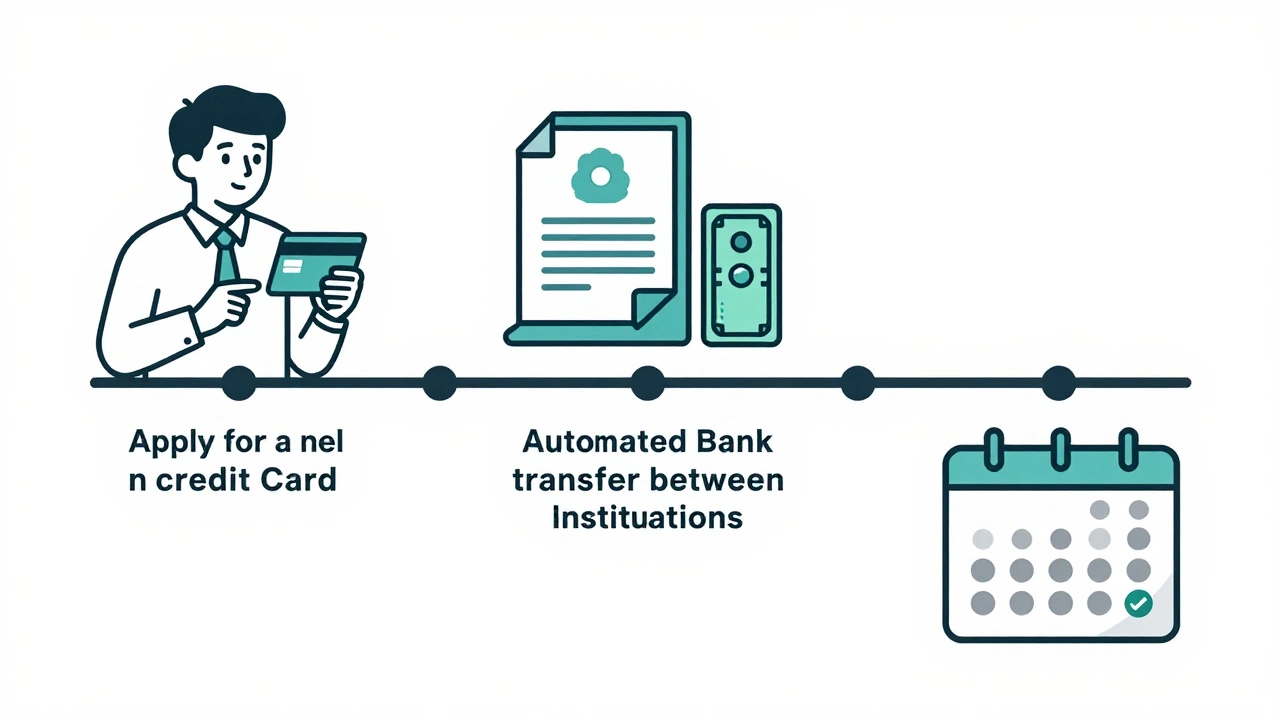
Here’s how it plays out: you apply for a new card with a 0% interest offer on transfers (often 6 to 18 months). If approved, the issuer pays your old card directly. Then, you owe the new card instead. No cash changes hands. It’s all paperwork and bank transfers.
But here’s the catch: most balance transfers charge a fee. Usually 2% to 5% of the amount you move. So if you transfer $5,000, you might pay $100 to $250 just to get the deal. That’s not free money-it’s a cost you have to factor in.
Why People Try This
Let’s say you’ve got a card charging 21.99% interest. You’re paying $92 a month in interest alone on a $5,000 balance. Now imagine switching to a card with 0% for 12 months. Suddenly, your entire $92 monthly payment goes toward reducing the principal. That’s a game-changer. In 12 months, you could wipe out the whole balance without paying a cent in interest.
That’s the dream. And it’s real-for people who can pay it off before the intro period ends. But if you only make minimum payments? You’ll hit the end of the 0% window and get slapped with the regular rate-maybe 22% or higher. Then you’re back where you started, plus you’ve paid a transfer fee.
The Hidden Costs
Most people focus on the interest rate and forget the fees. But there are other traps too.
- Transfer fees: Usually 2%-5%. Some cards waive them for a limited time, but those are rare.
- No new purchases: Many 0% offers only apply to transferred balances. Any new spending on the card might get hit with full interest right away.
- Missed payments: One late payment can kill your 0% deal. The issuer can cancel the offer and slap you with the standard rate retroactively.
- Credit score hit: Applying for a new card means a hard inquiry. If you’ve got a thin credit file or recent applications, your score might dip.
- Balance transfer limits: You can’t always transfer your full balance. The new card might cap transfers at 70% of your credit limit.
One real example from Brisbane: A customer transferred $8,000 from a card at 23.99% to a 0% offer with a 3% fee ($240). They planned to pay $700/month. That meant paying it off in 12 months-perfect. But they missed one payment. The 0% offer vanished. The remaining $3,200 got hit with 24.99% interest. They ended up paying $500 more than if they’d just stuck with the original card.
When It Makes Sense
This strategy works only if you meet all these conditions:
- You have a solid plan to pay off the balance before the 0% period ends.
- You won’t use the new card for new spending.
- You’ve never missed a payment in the last 12 months.
- Your credit score is above 680 (good to excellent).
- The transfer fee is less than the interest you’d pay on your old card during the payoff period.
Let’s say you owe $6,000 at 22% interest. Your minimum payment is $180/month. That’ll take you over 5 years to pay off-and you’ll pay $3,700 in interest. Now, find a card with 0% for 18 months and a 2.5% fee ($150). Pay $333/month. You clear it in 18 months. Total interest? $150. You save $3,550.
That’s not magic. That’s math.
When It’s a Bad Idea
Don’t do this if:
- You’re already maxed out on credit.
- You’re not sure you can pay it off in 12-18 months.
- You’re still using your old card for groceries or gas.
- Your credit score is below 600-you probably won’t qualify anyway.
- You’ve done this before and ended up with more debt.
One thing I’ve seen too often: people transfer a balance, feel relieved, and start spending again. Now they’ve got two cards with balances. One at 0% (but with a fee), and another at 22% with new charges. That’s how debt spirals.
Alternatives to Consider
Balance transfers aren’t the only option.
- Debt consolidation loan: A personal loan with a fixed rate and term. Often lower than credit card rates. No transfer fees. You get one payment. Many Australian lenders offer these for under $10,000.
- Speak to your bank: Some issuers will lower your rate if you ask. Especially if you’ve been a loyal customer.
- Debt management plan: Through a nonprofit like Financial Counselling Australia. They negotiate lower rates and combine payments into one.
For example, if you’ve got $10,000 across three cards, a $10,000 personal loan at 9.9% over 3 years means $320/month. No fees. No risk of losing a 0% deal. And you’re done in 36 months instead of 5+.
What to Look for in a Balance Transfer Card
Not all 0% offers are equal. Here’s what to compare:
| Card | Intro 0% Period | Transfer Fee | Post-Intro Rate | Minimum Credit Limit | Best For |
|---|---|---|---|---|---|
| Citi Simplicity | 20 months | 3% | 24.99% | $5,000 | Longest 0% window |
| NAB Low Rate | 18 months | 2.5% | 21.99% | $3,000 | Lower ongoing rate |
| Commonwealth Bank Low Fee | 12 months | 1.5% | 23.74% | $2,000 | Lowest transfer fee |
| Bankwest Breeze | 14 months | 2% | 22.99% | $4,000 | Balance of fee and length |
Rule of thumb: Aim for a card where the transfer fee is less than 3% and the 0% period is at least 12 months. If you can’t pay it off in 12, go for 18. If you can’t qualify for 18, then a personal loan might be smarter.

How to Do It Right
Follow these steps:
- Check your current balances and interest rates.
- Calculate how much you can pay each month.
- Find a card with a 0% offer longer than your payoff timeline.
- Apply for the card. Don’t apply for multiple cards-you’ll hurt your credit.
- Once approved, request the balance transfer immediately.
- Set up auto-pay for the minimum on the new card.
- Stop using the old card. Cut it up or freeze it.
- Stick to your plan. Pay more than the minimum.
One thing I always tell people: don’t wait for the perfect deal. If you’ve got a 21% card and a 0% offer for 12 months with a 2% fee, take it. The cost of waiting is interest piling up every day.
What Happens If You Can’t Pay It Off?
If you still owe money when the 0% period ends, you’ll be moved to the standard rate. That’s often 22%-25%. Now your monthly payment jumps. You might even get hit with a higher minimum payment.
At that point, you have two choices: transfer again (but you’ll pay another fee), or switch to a personal loan. Don’t keep doing balance transfers. It’s a cycle that rarely ends well.
And if you’re already behind? Talk to a free financial counsellor. Services like Financial Counselling Australia help people in this exact situation. They don’t charge. They don’t judge. They just help.
Can you pay off a credit card with another credit card?
Yes, but only through a balance transfer. You can’t just swipe the second card to pay the first. You need to apply for a new card with a 0% introductory offer on balance transfers. The issuer will pay your old card directly. But there’s usually a 2%-5% fee, and you must pay off the balance before the intro period ends-or you’ll get hit with high interest.
Is it a good idea to pay off one credit card with another?
It can be, if you have a clear plan to pay off the balance before the 0% period ends and you won’t use the new card for spending. If you’re unsure, or if you’ve struggled with debt before, it’s risky. A personal loan or speaking to a financial counsellor might be safer.
What’s the best way to pay off credit card debt?
The best way depends on your situation. If you have good credit and can pay off the balance in 12-18 months, a 0% balance transfer card can save you thousands. If you can’t, a personal loan with a fixed rate and term is often better. If you’re overwhelmed, free financial counselling services can help you create a realistic repayment plan.
Do balance transfers hurt your credit score?
Applying for a new card causes a hard inquiry, which can lower your score by 5-10 points. But if you pay down your debt, your credit utilization drops-which usually boosts your score more than the inquiry hurts it. The key is not applying for multiple cards and keeping old accounts open.
Can you transfer a balance from one card to another within the same bank?
No. Most banks won’t let you transfer a balance between their own cards. You need to move the debt to a card from a different issuer. That’s why you can’t transfer from a Citi card to another Citi card-only to a card from NAB, Westpac, or another bank.
What happens if I miss a payment during the 0% period?
You’ll likely lose the 0% offer. The issuer can apply the standard interest rate retroactively to your entire balance. That means you’ll owe interest on everything you transferred, plus any new interest. It can wipe out all your savings. Always set up auto-pay for at least the minimum.
How long does a balance transfer take?
It usually takes 7-14 business days. Some banks process it faster, but don’t rely on it being instant. Keep making payments on your old card until you see the transfer confirmed. If you stop paying and the transfer doesn’t go through, you’ll get late fees and damage your credit.
Final Thought
Paying off one credit card with another isn’t a trick. It’s a tool. Like a hammer-it can build something or smash it. If you’re disciplined, it can save you thousands. If you’re careless, it can cost you more. The difference isn’t the card. It’s your plan. And if you don’t have one? Start with a free financial counsellor. They’ve seen this story a hundred times. And they know how to help you write a better ending.