Car Finance Comparison Calculator
Enter your car details below to see if the 0% APR offer is actually cheaper than a standard bank loan when factoring in potential hidden costs.
Hidden Costs / Trade-offs
Comparison Results
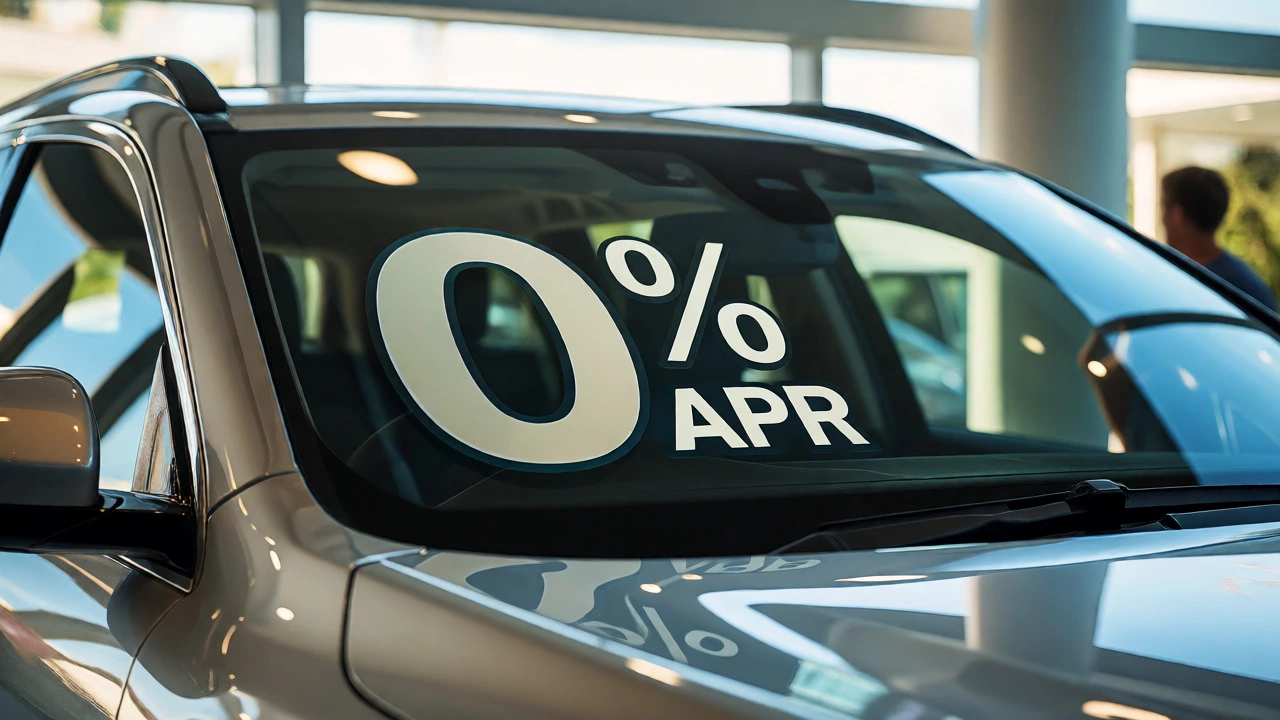
You see the sticker on the windscreen: 0% APR. It feels like a gift from the heavens. You’re buying a brand-new SUV, and for once, the bank isn’t taking a cut of your paycheck every month. But is it really free money? Or is there a catch hiding in the fine print that could cost you thousands down the track?
The short answer is yes, 0% APR means you pay zero interest on the principal amount borrowed. If you borrow $30,000 at 0% APR for five years, you will repay exactly $30,000 plus any applicable fees. However, the longer answer involves understanding how dealers make their profit when they aren’t charging you interest. In Australia, where we use the term "comparison rate" more often than "APR," these deals are common but come with specific trade-offs that can impact your wallet just as much as a standard loan.
What Does 0% APR Actually Mean?
To understand the deal, you need to know what the number represents. Annual Percentage Rate (APR) is a standardized way of calculating the cost of borrowing. It includes the interest rate plus certain fees, giving you a clearer picture of the total cost compared to just looking at the nominal interest rate. When a lender offers 0% APR, they are waiving this cost entirely for the life of the loan or for a promotional period.
In the context of car finance, this means your monthly repayment consists only of the portion of the car’s price you owe. There is no extra charge for the privilege of using someone else’s money. This sounds perfect, right? But remember, banks and manufacturers are businesses. They don’t lend money out of charity. If they aren’t making money on interest, they are making it somewhere else.
The Hidden Costs: Where the Money Comes From
If you aren’t paying interest, the dealership or manufacturer has to absorb that cost or recoup it elsewhere. Here is how they typically balance the books:
- Lower Trade-In Value: This is the most common trap. If you bring an old car to trade in against a new model financed at 0%, the dealer might offer you less for your current vehicle than you would get selling it privately. That difference effectively acts as a hidden interest payment.
- Reduced Discounts: A car listed at $40,000 might be discounted to $38,000 if you pay cash or take a standard loan. With a 0% finance deal, they might stick to the full $40,000 price tag. That $2,000 difference is essentially the interest you would have paid.
- Strict Terms and Fees: Some 0% deals come with higher establishment fees or require you to buy expensive add-ons like extended warranties or gap insurance through them. These products often have high markups.
It’s crucial to look at the total cost of ownership, not just the monthly repayment. A lower monthly payment doesn’t always mean a cheaper car.
Dealer Finance vs. Bank Loans: The Comparison
When deciding between a 0% dealer offer and a traditional bank loan, you need to compare the Total Amount Payable. Let’s look at a realistic scenario for a $35,000 car over a 5-year term.
| Feature | 0% Dealer Finance | Standard Bank Loan (6.5%) |
|---|---|---|
| Principal Amount | $35,000 | $35,000 |
| Interest Paid | $0 | Approx. $6,100 |
| Total Repayment | $35,000 + Fees | $41,100 + Fees |
| Monthly Repayment | ~$583 | ~$685 |
| Trade-In Impact | Potentially Lower | No Impact |
| Flexibility | Low (Fixed Term) | High (Can Refinance) |
In this example, the 0% deal saves you about $6,100 in interest. But if the dealer knocks $4,000 off your trade-in value and adds $500 in mandatory warranty packages, you’ve only saved $1,600. Is it worth the hassle? Sometimes yes, sometimes no. Always ask for a breakdown of the trade-in valuation separately from the finance terms.
Promotional Periods: The "Teaser" Trap
Not all 0% deals last for the entire loan term. Many are promotional periods, similar to credit card introductory rates. For example, a lender might offer 0% interest for the first 12 months, after which the rate jumps to 8% or 9%. This is known as a teaser rate.
Check the contract carefully. If the 0% period ends before you’ve paid off the balance, you could face a sudden spike in your monthly repayments. In Australia, lenders are required to disclose the comparison rate, which gives a better indication of the true long-term cost. If the comparison rate is significantly higher than the advertised rate, it’s a red flag that the 0% period is short-lived.
Impact on Your Credit Score
Taking out a car loan affects your credit profile regardless of the interest rate. Applying for multiple finance deals can lead to several hard inquiries on your credit report, which may temporarily lower your score. However, managing a 0% loan responsibly-making payments on time-can actually help build your credit history.
One thing to watch out for is debt-to-income ratio. Even though you aren’t paying interest, the loan itself counts as debt. If you plan to apply for a mortgage soon, having a large car loan on your books might reduce your borrowing capacity. Lenders look at your ability to service existing debts, so factor this into your broader financial planning.

How to Calculate if 0% is Worth It
Don’t just take the salesperson’s word for it. Do the math yourself using these steps:
- Get the Cash Price: Ask the dealer for the final price of the car if you were paying cash. Negotiate this first.
- Calculate the Loan Cost: Add up all the repayments for the 0% deal, including any upfront fees or mandatory add-ons.
- Compare to Bank Quotes: Get quotes from two or three banks for the same amount and term. Calculate the total repayment amount.
- Adjust for Trade-In: Estimate the private sale value of your trade-in. Subtract the dealer’s offer from this figure. This is your "hidden cost."
- Subtract and Decide: Take the savings from the lower interest and subtract the hidden costs. If the result is positive, the deal is good. If negative, pay cash or use a bank loan.
For instance, if you save $5,000 in interest but lose $3,000 on your trade-in and pay $500 in fees, you net $1,500. That’s a decent win, but it’s not the $5,000 windfall it initially appeared to be.
Australian Context: What You Need to Know
In Australia, the terminology differs slightly from the US. While "APR" is understood, Australian consumers rely heavily on the Comparison Rate. By law, lenders must display both the interest rate and the comparison rate. The comparison rate includes most fees and charges, providing a more accurate reflection of the loan's cost.
Be aware that some 0% deals are offered by captive finance companies owned by the car manufacturers themselves (like Toyota Finance or Ford Credit). These entities exist primarily to sell cars, not necessarily to maximize lending profits. They often have access to subsidized funds, allowing them to offer rates that independent banks cannot match. However, they may be stricter about early repayment penalties. Check if you can pay off the loan early without a fee; if you can’t, you lose the flexibility to refinance if interest rates drop.
Final Verdict: To Sign or Not to Sign?
Does 0% APR mean no interest? Yes. But does it mean no cost? Absolutely not. The cost is simply shifted from interest payments to other areas like vehicle pricing, trade-in values, or ancillary products.
These deals are excellent for people who want predictable monthly payments and have good credit scores. They are particularly useful if you plan to keep the car for the full term and won’t need to refinance. However, if you are a savvy negotiator who plans to sell the car in two years, or if you have strong bargaining power on the purchase price, a standard low-interest loan from your bank might actually leave more money in your pocket.
Always read the fine print. Look for the comparison rate, check for early termination fees, and negotiate the trade-in value independently. If you do your homework, 0% APR can indeed be one of the best ways to finance a new set of wheels.
Is 0% APR really free money?
No, it is not free money. While you do not pay interest, the cost is often embedded in the vehicle's purchase price, a lower trade-in value, or mandatory add-ons like insurance and warranties. The lender recoups their revenue through these channels instead of monthly interest charges.
Can I pay off a 0% APR loan early?
Usually, yes, but you must check the contract. Some 0% deals have minimum term requirements or early settlement fees. Unlike variable-rate loans where paying early saves interest immediately, paying off a fixed 0% loan early rarely saves you money since there was no interest accruing anyway. It simply frees up your cash flow sooner.
Does 0% APR affect my credit score?
Yes, applying for the loan results in a hard inquiry, which can slightly dip your score temporarily. However, successfully managing the loan by making on-time payments contributes positively to your payment history, which is a major factor in credit scoring models.
What is the difference between APR and Comparison Rate in Australia?
In Australia, the Comparison Rate is legally required and combines the interest rate with most upfront and ongoing fees. It provides a more accurate estimate of the total cost of the loan than the headline interest rate alone. Always compare loans based on the Comparison Rate, not just the advertised interest rate.
Should I choose 0% finance or a cash discount?
It depends on your financial situation. If you have the cash available and can invest it elsewhere for a return higher than the implied cost of the 0% deal, take the cash discount. If you prefer lower monthly outflows and lack investment opportunities beating the loan's implicit cost, the 0% finance is likely the better choice.