

Home Equity Impact Calculator
Your Current Situation
Equity Access Details
Imagine you’ve built up $100,000 in equity in your home. You need that money for a kitchen renovation or to pay off high-interest credit card debt. You decide to take out equity. Now, here is the burning question: does your monthly mortgage payment go up? Does the total amount you owe the bank skyrocket?
The short answer is yes. When you take out equity, you are borrowing against the value of your home. This means your loan balance increases. However, whether your *monthly payment* goes up depends entirely on how you access that equity. Are you doing a cash-out refinance? A Home Equity Loan? Or a HELOC? Each method changes your financial picture differently.
Let’s break down exactly what happens to your mortgage when you tap into your home’s value, so you don’t get blindsided by higher bills.
What Actually Happens When You Take Out Equity?
To understand if your mortgage goes up, you first need to understand what "equity" is. Equity is not cash in the bank. It is the difference between what your house is worth and what you still owe on your mortgage.
Home Equity is the portion of your home's value that you truly own, calculated by subtracting your outstanding mortgage balance from the current market value of the property.
If your home is worth $400,000 and you owe $300,000, you have $100,000 in equity. When you "take out" this equity, you aren't taking existing money out of a savings account. You are creating a new loan (or adding to an existing one) secured by your house.
This action triggers two immediate changes:
- Your Debt Increases: Your total mortgage balance goes up by the amount you borrow.
- Your Collateral Risk Increases: Your home secures more debt, meaning if you can't pay, the lender has a larger claim on your property.
The critical part is how that increased debt affects your monthly budget. Let’s look at the three main ways people do this.
Scenario 1: The Cash-Out Refinance (The Full Swap)
A cash-out refinance is like hitting the reset button on your entire mortgage. You replace your old loan with a brand-new, larger loan. You take the extra cash at closing.
For example, if you owe $300,000 and want $50,000, your new mortgage will be for $350,000.
Does your mortgage go up? Yes, significantly.
- Total Balance: Jumps from $300k to $350k.
- Monthly Payment: Usually increases because you are paying back a larger principal over a new 30-year term.
- Interest Rate: This is the wildcard. If current rates are lower than your original rate, your payment might stay the same or even drop slightly despite the larger loan. But in 2026, if rates are stable or rising, expect a higher payment.
This option is best if you want one single monthly payment and plan to stay in the home for a long time. It simplifies things but resets your clock on paying off the house.
Scenario 2: The Home Equity Loan (The Second Mortgage)
A Home Equity Loan is a lump-sum second mortgage. You keep your original first mortgage exactly as it is. You add a second loan on top of it.
Does your mortgage go up? Technically, no-your *first* mortgage stays the same. But your *total housing debt service* goes up.
You now have two separate payments to make every month:
- Your original mortgage payment.
- Your new home equity loan payment.
Home equity loans usually come with fixed interest rates and terms of 5 to 15 years. Because the term is shorter than a typical 30-year mortgage, the monthly payment on this second loan can be surprisingly high relative to the amount borrowed.
If you borrowed $50,000 on a 10-year term at 8% interest, your monthly payment would be around $607. Add that to your existing mortgage, and your total monthly housing cost definitely goes up.
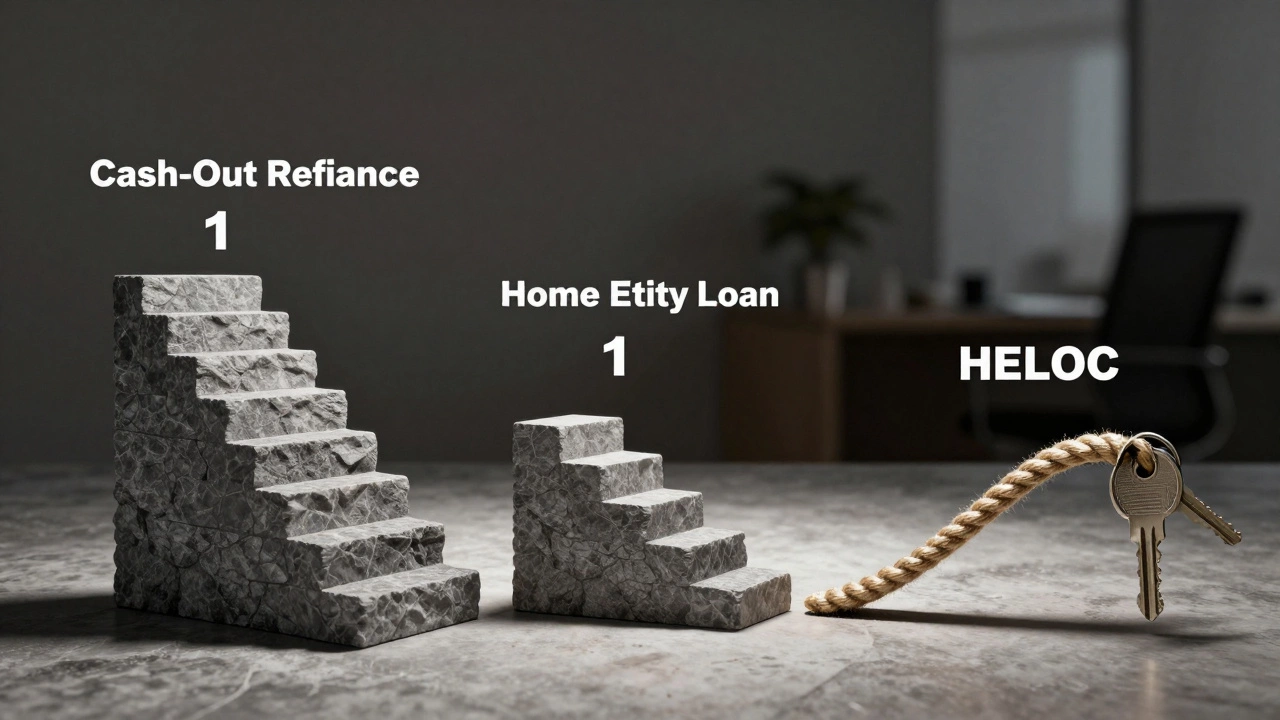
Scenario 3: The HELOC (The Credit Card Model)
A Home Equity Line of Credit (HELOC) works like a credit card secured by your home. You get a limit (say, $50,000), but you only pay interest on what you actually use.
Does your mortgage go up? Not immediately, and maybe not much later.
During the "draw period" (usually 5-10 years), you often only pay interest on the amount withdrawn. If you pull out $10,000, your monthly payment might be just $100-$150. If you don't pull any money out, your payment is zero.
However, once the draw period ends, you enter the "repayment period." Then, you must pay back the principal plus interest. This is where the payment shock hits. Your monthly obligation can triple or quadruple overnight if you haven't been paying down the principal during the draw period.
| Feature | Cash-Out Refinance | Home Equity Loan | HELOC |
|---|---|---|---|
| Effect on Original Mortgage | Replaced entirely | Unchanged | Unchanged |
| New Monthly Payment? | Yes (one combined payment) | Yes (second payment added) | Variable (interest-only initially) |
| Interest Rate Type | Fixed (usually) | Fixed | Variable (usually) |
| Best For | Large sums, long-term needs | One-time projects, predictable budget | Ongoing expenses, emergency funds |
| Risk Level | Medium (resets amortization) | Low (predictable payments) | High (payment shock risk) |
Hidden Costs That Make Your Mortgage "Go Up"
It’s not just about the monthly payment number. Taking out equity introduces costs that erode your net worth faster than you might think.
Closing Costs and Fees
Just like buying a house, pulling out equity costs money. Lenders charge appraisal fees, title insurance, origination fees, and processing charges. These can range from 2% to 5% of the loan amount. In a cash-out refi, these costs are often rolled into the loan, meaning you start owing more money before you even spend a dime.
Tax Implications
Previously, mortgage interest was broadly deductible. Today, the rules are stricter. Interest on a home equity loan is generally only tax-deductible if you use the funds to "buy, build, or substantially improve" the home that secures the loan. If you use equity to pay for a wedding, tuition, or vacation, that interest is likely not deductible. Always consult a tax professional, but assume the tax benefit is gone unless you are renovating.
Impact on Future Refinancing
Lenders look at your Loan-to-Value (LTV) ratio. If you max out your equity, your LTV rises. A high LTV makes it harder to refinance later if rates drop, because you have less buffer. You might find yourself stuck with a higher rate while neighbors with more equity switch to cheaper loans.

When Is It Worth the Higher Payment?
So, should you do it? Only if the return on investment (ROI) justifies the increased debt.
Good Reasons to Take Out Equity:
- Debt Consolidation: Swapping 20% credit card debt for 7% mortgage debt saves you thousands in interest. Just ensure you don't run up the credit cards again.
- Home Improvements: Adding a bathroom or finishing a basement can increase your home's value by more than the cost of the loan. This builds equity rather than destroying it.
- Education: Paying for college can lead to higher lifetime earnings, which helps you pay off the loan.
Bad Reasons to Take Out Equity:
- Lifestyle Spending: Buying a boat or funding a luxury vacation turns illiquid home equity into depreciating assets.
- Speculative Investing: Using home equity to bet on stocks or crypto is risky. If the market crashes, you still owe the bank, and they can foreclose on your house.
How to Protect Yourself From Payment Shock
If you decide to proceed, follow these rules to keep your finances safe.
- Keep LTV Below 80%: Most lenders cap equity loans at 80-85% of your home's value. Staying below 80% avoids private mortgage insurance (PMI) and keeps you safer if the housing market dips.
- Choose Fixed Rates When Possible: Variable rates on HELOCs can rise quickly. If you need predictability, a fixed-rate home equity loan or a fixed cash-out refi is safer.
- Create a Repayment Plan: Don't just make the minimum payment. Set up automatic payments that include principal reduction, especially for HELOCs.
- Shop Around: Get quotes from at least three lenders. Banks, credit unions, and online lenders all have different fee structures. A small difference in interest rate can save you tens of thousands over the life of the loan.
Final Thoughts on Leveraging Your Home
Taking out equity is a powerful tool, but it’s not free money. It is a loan that puts your home at risk. Your mortgage balance will always go up when you borrow against your home. Your monthly payment will likely go up too, unless you secure a significantly lower interest rate through a cash-out refinance.
Before signing anything, calculate your new total monthly housing cost. Can you afford it if you lose your job? If the answer is yes, and you have a clear plan for using the funds wisely, then tapping your equity can be a smart financial move. If not, leave that equity alone and let it grow.
Will my monthly payment go up if I take out equity?
In most cases, yes. If you do a cash-out refinance, your new loan balance is higher, which typically increases your monthly payment unless you secure a much lower interest rate. If you choose a Home Equity Loan or HELOC, you will have an additional monthly payment on top of your existing mortgage, increasing your total housing costs.
Does taking out equity affect my credit score?
Yes, temporarily. Applying for a home equity loan or refinance involves a hard credit inquiry, which can drop your score by a few points. Additionally, opening a new line of credit lowers your average account age. However, making consistent, on-time payments on the new loan can help rebuild your score over time.
Can I lose my home if I can't repay the equity loan?
Yes. Both Home Equity Loans and HELOCs are secured by your home. If you default on either loan, the lender has the right to foreclose on your property, regardless of whether you are still paying your primary mortgage on time.
Is interest on a home equity loan tax-deductible?
Only if you use the funds to buy, build, or substantially improve the home that secures the loan. Interest on equity used for other purposes, such as debt consolidation or personal expenses, is generally not tax-deductible under current US tax laws. Consult a tax advisor for your specific situation.
What is the maximum amount of equity I can take out?
Most lenders allow you to borrow up to 80% to 85% of your home's appraised value, minus your existing mortgage balance. Some lenders may go up to 90% or 95%, but this often requires private mortgage insurance (PMI) and carries higher risk.
Which is better: a cash-out refinance or a HELOC?
It depends on your needs. Choose a cash-out refinance if you want a lower interest rate, a fixed payment, and a large lump sum for a long-term project. Choose a HELOC if you need flexibility, only require a small amount of money initially, or want to avoid closing costs associated with refinancing your entire mortgage.
How long does it take to get equity released?
A cash-out refinance typically takes 30 to 45 days to close, similar to a standard mortgage. A Home Equity Loan or HELOC can be faster, often closing in 2 to 3 weeks, depending on the lender and the complexity of your financial situation.
Can I take out equity if I have bad credit?
It is difficult. Most lenders require a minimum credit score of 620 to 680 for home equity products. If your credit is poor, you may face higher interest rates or be denied entirely. Improving your credit score before applying can save you thousands in interest.