Rule of 72 Investment Calculator
Enter an annual interest rate to see how many years it will take for your investment to double in value.
Years
to double your money at % annual return
The Math:
72 ÷ =
Common Investment Scenarios
| Investment Type | Est. Return | Doubling Time |
|---|---|---|
| Big Bank Checking | 0.5% | 144 years |
| High-Yield Savings | 4.5% | 16 years |
| Balanced Portfolio | 7% | 10.3 years |
| Stock Index Fund | 10% | 7.2 years ✓ |
Imagine putting $10,000 into a jar today. Seven years from now, you open that same jar and find $20,000 inside. No extra work, no lottery tickets, just pure mathematical growth. It sounds like a dream, but it is actually a very achievable financial goal if you understand how interest works against time.
The secret isn't magic; it's math. Specifically, it is the power of compounding. To double your money in exactly seven years, you need an annual return of roughly 10.4%. This might sound steep compared to the 0.5% or 1% most standard bank accounts offer, but it is well within reach if you move beyond basic savings and look at smarter vehicles for your cash.
The Magic Number: Understanding the Rule of 72
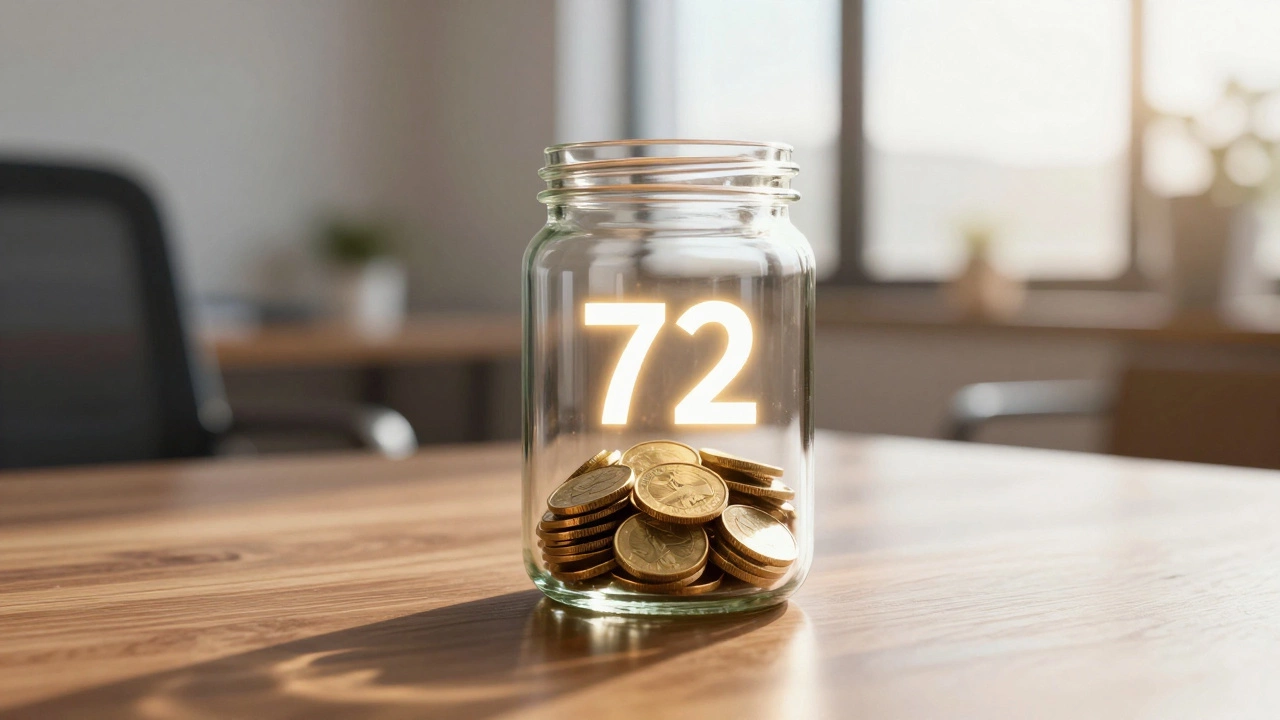
Before we talk about where to put your money, you need a quick calculator for your brain. Financial planners use a simple shortcut called the Rule of 72, which is a mental math trick used to estimate how long an investment will take to double given a fixed annual rate of interest.
Here is how it works: You take the number 72 and divide it by the annual interest rate (or expected return). The result is the number of years it takes for your money to double.
- At 1% interest: 72 / 1 = 72 years. That is why keeping cash under a mattress or in a low-interest checking account is expensive.
- At 5% interest: 72 / 5 = 14.4 years. Better, but still slow.
- At 10% interest: 72 / 10 = 7.2 years. Boom. You are right on target.
This formula shows you clearly that to hit that seven-year mark, you cannot rely on traditional savings accounts alone. You need an environment that generates returns closer to 8%, 9%, or 10% annually. Let’s break down the realistic ways to get there.
Why Standard Savings Accounts Fail the Test
Let’s be honest about the current landscape. As of mid-2026, many big national banks are still offering rates between 0.01% and 0.5% on their basic savings products. If you put $10,000 in one of these accounts, after seven years, you would have approximately $10,350. You haven’t doubled your money; you’ve barely kept up with inflation.
Inflation is the silent thief here. If prices rise by 3% a year, your purchasing power drops even if your bank balance stays the same. To truly "double" your wealth in real terms, you need to beat inflation significantly. This is why moving money from a standard checking account to a higher-yield vehicle is step one.
| Annual Interest Rate | Vehicle Type Example | Value After 7 Years | Did It Double? |
|---|---|---|---|
| 0.5% | Big Bank Checking | $10,355 | No |
| 4.5% | High-Yield Savings Account (HYSA) | $13,585 | No |
| 7.0% | Balanced Investment Portfolio | $16,057 | No |
| 10.4% | Growth Stock Index Fund | $20,000 | Yes |
Strategy 1: The High-Yield Savings Account (HYSA) Boost
If you are risk-averse and want your principal guaranteed, you can start with a High-Yield Savings Account, which is a deposit account offered by online banks that pays a significantly higher interest rate than traditional brick-and-mortar banks. These accounts are FDIC-insured, meaning your money is safe up to $250,000.
In 2026, competitive HYSAs are offering rates between 4% and 5%. While this won't double your money in seven years (it takes about 14-18 years at these rates), it is the essential first step for emergency funds. It sets the stage. You can't invest everything, but you can optimize the cash you hold back.

Strategy 2: Certificates of Deposit (CDs) for Steady Growth
If you can lock your money away, Certificates of Deposit (CDs) often pay slightly more than savings accounts. A CD requires you to commit your funds for a set term-say, 12 months, 24 months, or 5 years-in exchange for a fixed interest rate.
To chase that 10% return, CDs alone won't cut it unless interest rates spike dramatically. However, they are great for laddering. You buy multiple CDs with different maturity dates. When one matures, you reinvest it. This reduces risk while capturing higher yields than savings accounts. Think of CDs as the "steady hand" in your portfolio, not the sprinter.
Strategy 3: The Market Average (Index Funds)
Here is the hard truth: to double your money in seven years consistently, you likely need to expose your capital to the stock market. Historically, the S&P 500 has returned an average of about 10% per year over long periods, though past performance never guarantees future results.
You don't need to pick individual stocks. You can buy a low-cost index fund that tracks the entire market. By spreading your money across hundreds of companies, you reduce the risk of any single company failing wiping you out. Over a seven-year horizon, the volatility smooths out somewhat. This is the most realistic path for most people to hit that 10.4% target without gambling on risky assets.
Strategy 4: Dividend Reinvestment Plans (DRIPs)
If you prefer owning actual businesses, look for companies with strong dividend histories. But here is the key: you must reinvest those dividends. When a company pays you cash for holding its stock, you automatically use that cash to buy more shares. This creates a snowball effect. You own more shares, which generate more dividends, which buy more shares. This is compounding in action, accelerated by corporate profits rather than just bank interest.

Risk vs. Reward: What Could Go Wrong?
Chasing a 10% return comes with risks. Higher potential reward always equals higher potential loss. In the stock market, a seven-year period could include a recession. Your portfolio might drop 20% in year three before bouncing back in year five. Can you handle seeing your $10,000 turn into $8,000 temporarily? If the answer is no, you should lower your expectations and accept that doubling your money might take 10 or 12 years instead of seven.
Also, beware of "get rich quick" schemes. If someone promises you 20% guaranteed returns with zero risk, run. That is a scam. Legitimate finance is boring. It involves patience, discipline, and watching numbers grow slowly but surely.
Step-by-Step Action Plan
Ready to start? Here is your checklist to begin doubling your money in seven years:
- Assess Your Risk Tolerance: Be honest. Can you sleep at night if your investment drops 15%? If yes, lean toward stocks. If no, stick to HYSA and CDs, accepting a longer timeline.
- Open a Brokerage Account: Use a reputable platform with low fees. Fees eat into your compounding. Look for platforms that allow fractional shares so you can start with small amounts.
- Choose Your Vehicle: For broad exposure, select a total stock market index fund or an S&P 500 ETF. Keep expense ratios below 0.10%.
- Set Up Automatic Contributions: Consistency beats timing. Set up an automatic transfer from your paycheck to your investment account every month.
- Reinvest Everything: Turn on DRIP (Dividend Reinvestment Plan) settings in your brokerage app. Do not withdraw the dividends.
- Ignore the Noise: Do not check your portfolio daily. Check it quarterly. Adjust only if your life circumstances change drastically.
Tax Implications You Must Consider
Making money is half the battle; keeping it is the other half. In taxable brokerage accounts, you may owe taxes on dividends and capital gains when you sell. This drags down your net return. To maximize compounding, consider using tax-advantaged accounts like IRAs (Individual Retirement Accounts) or 401(k)s if you are eligible. In these accounts, your money grows tax-deferred or tax-free, allowing the full force of compounding to work without government cuts along the way.
For example, if you earn 10% but pay 15% in taxes on the gains each year, your effective return drops to 8.5%. That changes your doubling time from 7.2 years to nearly 9 years. Tax efficiency is a silent multiplier.
Can I double my money in 7 years with just a savings account?
It is highly unlikely with standard savings accounts. Even high-yield savings accounts currently offer around 4-5%, which would take about 14-18 years to double your money using the Rule of 72. To double in 7 years, you need a return of roughly 10.4%, which typically requires investing in the stock market through index funds or equities.
Is it risky to try to double money in 7 years?
Yes, there is moderate to high risk. Achieving a 10% annual return usually involves investing in stocks, which fluctuate in value. You might see temporary losses during market downturns. If you need the money urgently within those 7 years, this strategy is dangerous. It works best for goals where the timeline is flexible and you can ride out market volatility.
What is the Rule of 72?
The Rule of 72 is a simple formula used to estimate the number of years required to double your investment at a given annual rate of return. You divide 72 by the interest rate. For example, at a 9% return, 72 divided by 9 equals 8 years. It is a quick mental math tool for comparing investment options.
Should I use an IRA to double my money?
Using an IRA (Individual Retirement Account) is often smarter because of tax benefits. In a Traditional IRA, you defer taxes until withdrawal; in a Roth IRA, qualified withdrawals are tax-free. Taxes can significantly reduce your compounding growth in a regular taxable account, so using tax-advantaged wrappers helps you reach your doubling goal faster.
What if the market crashes in year 3?
If you are invested in the market, a crash is possible. However, historical data shows that markets tend to recover over time. If you do not need the money immediately, staying invested allows you to benefit from the eventual rebound. Panic selling locks in losses. Patience is the key ingredient in the 7-year doubling strategy.