

Let’s cut through the noise. You’ve seen the headlines: someone turned $1,000 into $1 million. You’ve heard the hype: "This is the future of money." But when you look at your own bank account, you wonder - is investing in cryptocurrency actually a smart move for you? The truth isn’t glamorous. It’s messy, unpredictable, and full of traps. And if you’re not ready for that, you shouldn’t be doing it.
Cryptocurrency isn’t like stocks
Most people treat crypto like a stock market gamble. They think if they buy Bitcoin or Ethereum, they’re investing in a company. They’re wrong. Cryptocurrency is a digital asset with no underlying business, no earnings, and no dividends. Unlike Apple or Tesla, Bitcoin doesn’t make a profit. It doesn’t pay you anything. Its value comes entirely from what other people are willing to pay for it.
This is called the "greater fool theory" - you buy it hoping someone else will pay more later. There’s no cash flow. No balance sheet. No management team. Just code, consensus, and hype. That’s not investing. That’s speculation.
The volatility isn’t a bug - it’s the feature
In 2021, Bitcoin hit $69,000. By late 2022, it dropped to $15,600. That’s a 77% crash in under a year. In 2023, it climbed back to $72,000. Then in early 2024, it fell 30% in three weeks after a single regulatory announcement. These aren’t anomalies. They’re normal.
Ethereum is just as wild. It surged 800% in 2021, then lost 60% in 2022. In 2025, it hit $4,500 - then dropped to $2,800 in a single week because of a smart contract glitch. If you can’t sleep when your portfolio drops 40% overnight, you’re not cut out for crypto.
Most crypto projects fail
There are over 25,000 cryptocurrencies in existence. Only about 100 have any real trading volume. And of those, maybe 10 have lasting value. The rest? They’re dead. Forgotten. Gone.
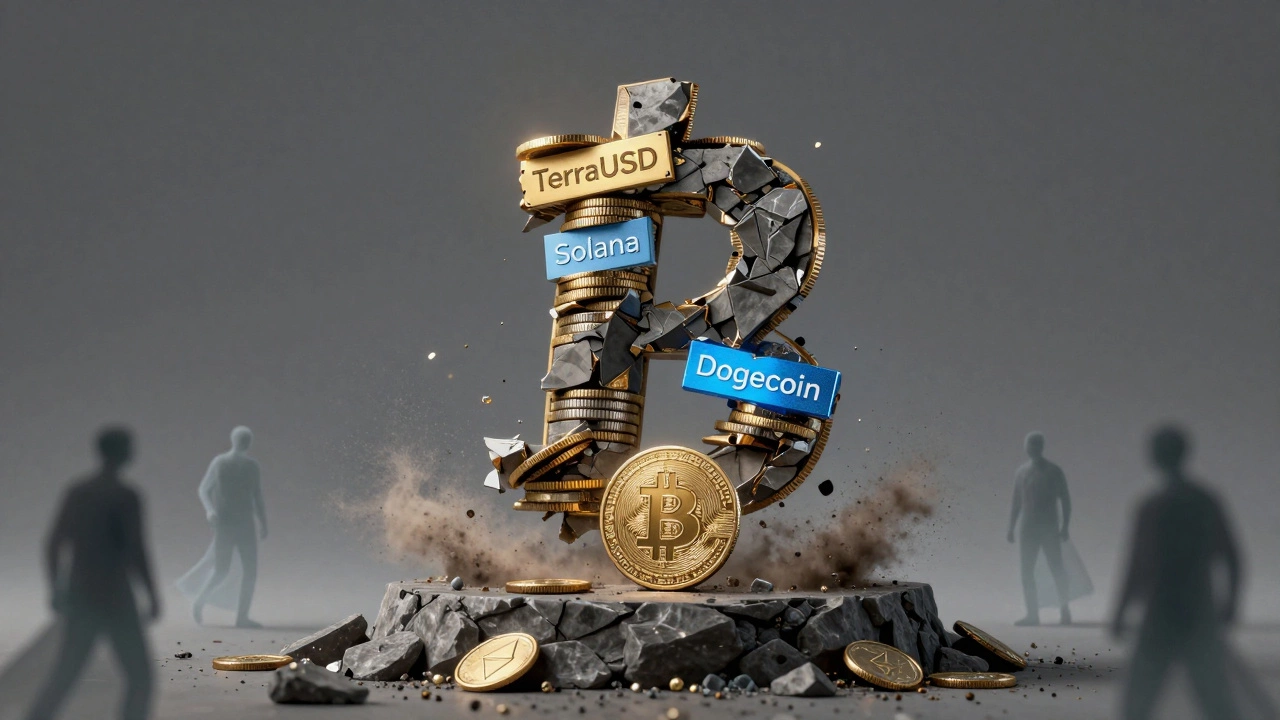
Remember TerraUSD? In 2022, it was a $40 billion stablecoin. One algorithmic hiccup, and it collapsed to 10 cents. Over $40 billion vanished in days. Investors lost everything. That’s not an outlier. That’s the rule.
Most new tokens are launched by anonymous teams with no track record. They promise moonshots. They get listed on exchanges. They pump. Then they dump. The people who bought in early? They’re long gone. The ones who bought at the peak? They’re still waiting.
Regulation is coming - and it’s not gentle
The U.S. SEC has sued Coinbase, Binance, and Kraken. The EU passed MiCA, a full regulatory framework for crypto. Australia’s ASIC is now requiring crypto exchanges to hold licenses. China banned all trading. India slapped a 30% tax on crypto gains.
This isn’t about "cracking down." It’s about bringing crypto into the same system as everything else. That means taxes, reporting, KYC, and compliance. And that’s going to kill the wild west.
Right now, you can buy crypto with a credit card and send it to a wallet with no name attached. That won’t last. In 2026, exchanges will be required to report every transaction to tax authorities. If you’re holding crypto without reporting it, you’re already at risk.
The only real use cases are few
Let’s be honest: most people use crypto for one thing - speculation. But there are a few legitimate uses.
- Bitcoin as digital gold: Some people hold it as a hedge against inflation. But gold has been used for 5,000 years. Bitcoin? Less than 15.
- Ethereum for smart contracts: It powers decentralized apps, DeFi platforms, and NFT marketplaces. But even here, most projects are underused or abandoned.
- Cross-border payments: A few companies use crypto to move money between countries faster and cheaper than banks. But even Ripple and Stellar have struggled to gain real traction.
Outside of those, crypto doesn’t solve a problem most people have. It doesn’t make paying rent easier. It doesn’t help you buy a car. It doesn’t reduce your grocery bill.
What actually works? A few hard truths
Here’s what you need to know if you’re still considering it:
- Only invest what you can afford to lose 100%. If losing $5,000 would ruin your month, don’t put it in crypto.
- Stick to Bitcoin and Ethereum. They’re the only two with real liquidity, network effects, and institutional adoption. Anything else is a lottery ticket.
- Use dollar-cost averaging. Don’t try to time the market. Put in $100 a month. No matter if it’s up or down. This reduces emotional decisions.
- Store it yourself. If you leave crypto on an exchange, you don’t own it. Use a hardware wallet like Ledger or Trezor. Learn how to back up your seed phrase.
- Tax it properly. Every trade, every swap, every airdrop is taxable. Track everything. Use a tool like Koinly or CoinTracker.

Who should avoid crypto entirely?
If any of these sound like you - skip it:
- You’re saving for a house in the next 3 years.
- You’re living paycheck to paycheck.
- You’re chasing quick riches.
- You don’t understand how blockchain works.
- You’ve already maxed out your retirement accounts.
Crypto isn’t a replacement for a 401(k), an emergency fund, or a diversified portfolio. It’s a high-risk bet on a new technology that may or may not matter in 10 years.
What’s the alternative?
If you want exposure to innovation without the rollercoaster, look at:
- Stocks in blockchain companies: Coinbase, MicroStrategy, NVIDIA - companies that build infrastructure around crypto.
- ETFs that hold Bitcoin: The BITCOIN ETF (BITO) lets you buy Bitcoin through a regulated exchange without holding the actual asset.
- Gold or commodities: They’ve held value for centuries. They’re not sexy, but they don’t crash 70% in a year.
These aren’t perfect. But they’re grounded in reality.
Final answer: Is it a good investment?
No - if you’re looking for safety, stability, or growth tied to real value.
Maybe - if you’re okay with gambling on a wild, unregulated, high-risk asset class with no guarantees.
Most people who get rich in crypto didn’t get rich from buying tokens. They got rich by buying early - before the hype. And they sold before the crash.
If you’re reading this in 2026, thinking you can catch the next wave - you’re already too late.
Is cryptocurrency safe to invest in?
No investment is "safe," but crypto is among the riskiest. It has no government backing, no regulatory protection, and extreme price swings. If you lose your private key or get hacked, there’s no recovery. Unlike banks, crypto exchanges aren’t insured. You’re on your own.
Can you make money with cryptocurrency?
Yes - but not like you think. Most people who profit in crypto do so by buying Bitcoin or Ethereum early and holding for years. The majority of traders lose money due to emotional decisions, FOMO, and poor timing. If you’re looking for quick gains, you’re more likely to lose than win.
Should I put all my savings into crypto?
Absolutely not. Never put your emergency fund, down payment, or retirement money into crypto. It’s not a savings account. It’s a speculative asset. Experts recommend no more than 1-5% of your total portfolio go into crypto - if at all.
What’s the difference between Bitcoin and altcoins?
Bitcoin is the original, most trusted, and most liquid cryptocurrency. Altcoins (like Solana, Dogecoin, or Shiba Inu) are alternatives with varying goals - faster transactions, smart contracts, memes. But most altcoins lack real adoption, have weak security, and vanish when the market turns. Bitcoin has survived crashes, bans, and skepticism. Altcoins have not.
Do I need to pay taxes on crypto gains?
Yes. In Australia, the U.S., the EU, and most major economies, crypto is treated as property. Every time you sell, trade, or use crypto to buy something, you trigger a taxable event. Failing to report can lead to audits, penalties, or even criminal charges. Keep detailed records of every transaction.
Is now a good time to buy crypto?
There’s no such thing as a "good time" to buy crypto based on timing. Prices swing wildly based on news, rumors, and sentiment. Instead of trying to time the market, use dollar-cost averaging: invest a fixed amount regularly, regardless of price. This removes emotion and spreads your risk over time.
If you’re still thinking about crypto, ask yourself this: Are you investing - or gambling? If it’s the latter, you’re not alone. But you’re also not building wealth. You’re just betting.