
Retirement Plan Comparison Tool
Your Inputs
Results
Pension (Defined Benefit)
Estimated Monthly Income at Retirement:
$0
*Based on standard 1.5% multiplier per year of service.
401(k) (Defined Contribution)
Projected Total Balance:
$0
*Includes employer match and compound growth.
The Great Retirement Debate: Guaranteed Income vs. Investment Control
Imagine two paths to your golden years. On one side, you have a steady paycheck that arrives every month for the rest of your life, regardless of how the stock market performs. On the other, you have an investment account where your retirement depends entirely on how well you pick stocks and how lucky you are with market timing. This is the core difference between pensions (specifically defined benefit plans) and 401(k)s (defined contribution plans).
For decades, the pension was the gold standard. You worked for a company, they promised you a specific income later, and you didn't have to think about it much anymore. Today, that model is vanishing in the private sector, replaced by the 401(k), which puts the burden of saving and investing squarely on your shoulders. So, which is actually better? The answer isn't just about math; it's about psychology, risk tolerance, and how much control you want over your financial destiny.
Understanding the Core Mechanics: Who Holds the Risk?
To decide which is better, you first need to understand who is holding the bag if things go wrong. In a traditional pension plan, also known as a defined benefit plan, the employer takes on the investment risk. They manage the fund, hire the actuaries, and promise you a specific payout formula based on your salary and years of service. If the market crashes, the employer still owes you that money. It is a guarantee.
In contrast, a 401(k) is a defined contribution plan. Your employer might match your contributions, but the account balance belongs to you. If you invest aggressively and the market booms, you win big. If you retire during a recession and your portfolio drops 30%, that loss is yours forever. There is no safety net from the employer once you leave the job. The risk shifts from the corporation to the individual.
This fundamental shift changes everything. A pension is like renting a house with a fixed lease-you know exactly what you'll pay. A 401(k) is like buying a house with a variable-rate mortgage-the value fluctuates, and you bear the consequences of market swings.
The Case for Pensions: Stability and Simplicity
Why do people still dream about pensions? Because they remove anxiety. When you have a traditional pension, you don't need to be a financial expert. You don't need to rebalance your portfolio or worry about asset allocation. You just show up to work, stay for a while, and collect your check. For many workers, this simplicity is priceless.
Pensions also protect against longevity risk. Longevity risk is the fear of outliving your savings. With a pension, if you live to be 105, the checks keep coming. With a 401(k), if you withdraw too little early on and then live longer than expected, you might run out of money at age 95. Most pensions offer a "life annuity" structure, which is essentially insurance against dying too soon financially.
Furthermore, pensions often include cost-of-living adjustments (COLAs). While not all do, many public sector pensions and some corporate ones adjust payouts annually to match inflation. This means your purchasing power stays relatively stable even as prices rise. In a 401(k), inflation eats away at your returns unless you actively invest in assets that beat inflation, which requires skill and discipline.

The Case for 401(k)s: Portability and Growth Potential
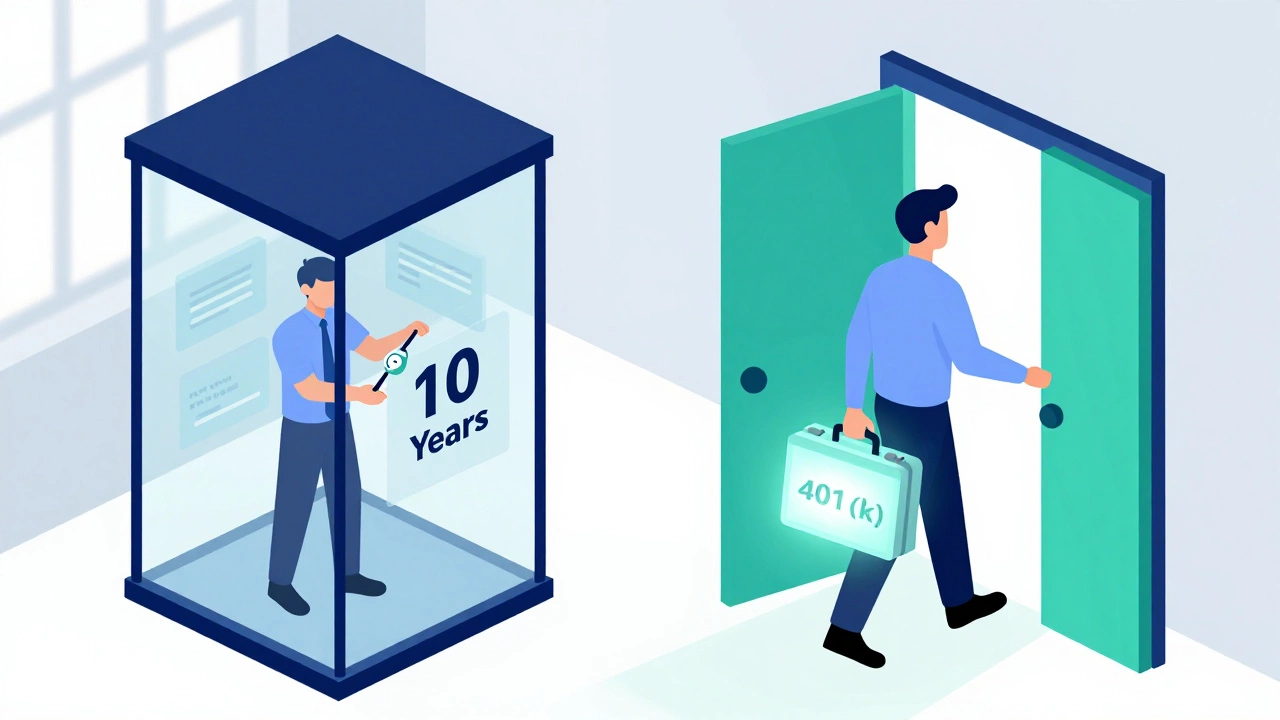
If pensions sound so good, why did they disappear? Because they are expensive and inflexible for employers. But for employees, the 401(k) offers advantages that pensions cannot match. The biggest is portability. In today's gig economy, where the average person changes jobs every three to five years, a pension is a trap. If you leave before vesting (often after five years), you lose most or all of your benefits. A 401(k) is always yours. You can take it with you when you change jobs, roll it into an IRA, or leave it invested.
Then there is the potential for higher returns. Pension funds are typically conservative, focused on preserving capital to meet future liabilities. This often results in lower growth rates. A 401(k) allows you to invest in high-growth assets like index funds, tech stocks, or real estate trusts. Over a 30-year horizon, aggressive compounding in a 401(k) can result in a significantly larger nest egg than a typical pension payout, especially if you maximize employer matches.
Let's look at the numbers. An employer match in a 401(k) is essentially free money. If your employer matches 50% of your contributions up to 6% of your salary, that is an immediate 50% return on your investment. No pension formula can compete with that instant boost. Plus, you have tax advantages. Traditional 401(k) contributions reduce your taxable income now, while Roth 401(k) options allow for tax-free withdrawals later. This flexibility lets you tailor your tax strategy to your current and future income levels.
Comparing the Two: A Side-by-Side Look
| Feature | Pension (Defined Benefit) | 401(k) (Defined Contribution) |
|---|---|---|
| Risk Bearer | Employer | Employee |
| Income Guarantee | Yes, for life | No, depends on withdrawals |
| Portability | Low (tied to job tenure) | High (fully portable) |
| Growth Potential | Conservative/Limited | High (depends on investments) |
| Control | None (managed by employer) | Full (you choose investments) |
| Vesting | Often required (e.g., 5-10 years) | Immediate for employee contributions |
Who Should Choose Which Path?
There is no universal winner. The "better" option depends entirely on your personality and career trajectory. If you are a risk-averse person who values stability above all else, a pension is superior. It provides peace of mind. You know exactly what your budget will look like in retirement. This is particularly valuable for those in public service, education, or government jobs where these plans are still common.
However, if you are entrepreneurial, likely to change jobs frequently, or confident in your ability to invest, a 401(k) is likely better for you. The portability ensures you don't lose progress when switching careers. The growth potential allows you to build wealth faster than a fixed formula. Moreover, if you are disciplined enough to save consistently and invest wisely, a 401(k) can provide more flexibility in retirement. You can choose when to retire, how much to withdraw, and how to allocate assets among heirs.
Consider this scenario: You are 30 years old and working for a tech startup. The company offers a 401(k) with a generous match but no pension. Another offer comes from a utility company with a pension but no match. If you stay at the utility company for 30 years, the pension might win due to the guaranteed income. But if you jump ships every few years to chase higher salaries, the 401(k) accumulates more value because you keep the vested assets and compound interest works across multiple accounts.
Hybrid Approaches and Modern Trends
The line between pensions and 401(k)s is blurring. Many companies now offer hybrid plans, such as cash balance plans. These look like pensions because they promise a specific annual credit to your account, but they function like 401(k)s because the money is portable and owned by you. This gives you the best of both worlds: predictable growth without the lack of portability.
Additionally, the rise of target-date funds in 401(k)s has reduced the complexity of investing. These funds automatically adjust their risk level as you approach retirement, mimicking the professional management of a pension fund. This makes 401(k)s more accessible to people who don't want to pick individual stocks.
Another trend is the increase in auto-enrollment and auto-escalation features in 401(k)s. These nudges help employees save more without thinking about it, addressing the behavioral gap that pensions used to fill. By making saving automatic, 401(k)s are becoming more effective at building retirement security for the average worker.
Strategic Advice for Maximizing Your Retirement
Regardless of which plan you have, here are some actionable steps to ensure you're set up for success:
- Maximize Employer Matches: If you have a 401(k), contribute at least enough to get the full employer match. It is the highest-return investment available.
- Understand Vesting Schedules: If you have a pension, know exactly when you become fully vested. Leaving before this date can mean losing years of accrued benefits.
- Diversify Investments: In a 401(k), avoid putting all your money in one stock or fund. Use low-cost index funds to spread risk.
- Review Beneficiaries: Update your beneficiary designations regularly. Unlike pensions, which may have survivor benefits, 401(k)s pass directly to named beneficiaries.
- Plan for Healthcare Costs: Neither plan fully covers healthcare in retirement. Consider health savings accounts (HSAs) as a third pillar of your retirement strategy.
Remember, the goal is not just to accumulate money, but to create a sustainable income stream. A pension does this automatically. A 401(k) requires you to design that stream yourself. Both can work, but only if you understand how they function and align them with your personal goals.
Is a pension better than a 401(k) for someone who changes jobs often?
No. Pensions are tied to long-term employment with a single employer. If you leave before vesting, you may lose most benefits. A 401(k) is fully portable, allowing you to move your savings with you when you change jobs.
Can I have both a pension and a 401(k)?
Yes. Some employers offer both, though this is rare in the private sector. More commonly, you might have a pension from a previous job and a 401(k) from your current one. It is wise to consolidate or manage both strategically.
What happens to my pension if my employer goes bankrupt?
In the US, the Pension Benefit Guaranty Corporation (PBGC) insures most private-sector pensions. However, there are limits to coverage, and you might receive less than promised if the plan is underfunded. Public sector pensions are generally backed by state governments.
Which option offers better tax advantages?
Both offer tax-deferred growth. However, 401(k)s often provide more flexibility with Roth options (tax-free withdrawals) and immediate tax deductions on contributions. Pension payouts are taxed as ordinary income upon receipt.
How do I calculate the value of my pension versus my 401(k)?
Use a present value calculator. For pensions, estimate future monthly payments and discount them back to today's dollars using a safe withdrawal rate (e.g., 4%). For 401(k)s, compare the current balance plus projected growth. This helps you see which plan holds more actual wealth.