
Debt-to-Income Ratio Calculator
Calculate Your Debt-to-Income Ratio
Enter your monthly income and debt payments to see if you qualify for debt consolidation
There’s a moment when you realize you’re juggling too many bills. Credit cards, personal loans, medical bills, even that buy-now-pay-later debt from last Christmas - all with different due dates, interest rates, and minimum payments. You start thinking: debt consolidation might be the way out. But here’s the question no one tells you: How much debt is too much to consolidate?
There’s no magic number - but there are red flags
Some advisors say you can consolidate up to 80% of your home’s value. Others say if your total debt is over five times your annual income, you’re in trouble. The truth? It’s not about the dollar amount. It’s about whether consolidation actually fixes your problem - or just hides it.
Take Sarah, a single mum from Ipswich. She had $42,000 in credit card debt, a $15,000 personal loan, and $8,000 in medical bills. Her monthly payments were $1,850. She earned $5,200 a month after tax. She qualified for a debt consolidation loan at 8.9% interest, which lowered her monthly payment to $1,100. On paper, it looked perfect. But she didn’t change how she spent. Six months later, her credit cards were back to $38,000 - and she’d added another $6,000 in new debt. The consolidation didn’t solve anything. It just gave her breathing room… and a bigger mess later.
The real question isn’t “Can I consolidate this much?” It’s “Will I stop digging after I do?”
Debt-to-income ratio is your real test
Lenders don’t care how much you owe. They care about how much you earn compared to how much you owe. That’s your debt-to-income ratio (DTI). In Australia, most lenders won’t approve a consolidation loan if your DTI is above 40%. Some strict ones cap it at 30%.
Here’s how to calculate yours:
- Add up all your monthly debt payments - credit cards, car loans, student loans, personal loans, even child support.
- Divide that total by your gross monthly income (before tax).
- Multiply by 100.
Example: You make $6,000 a month before tax. Your total monthly debt payments are $2,100. Your DTI is 35% ($2,100 ÷ $6,000 × 100). That’s acceptable. If you’re making $4,500 a month and paying $2,000 in debt? That’s a 44% DTI. You’re already in the danger zone.
Most people don’t realize how high their DTI is until they sit down and add it up. And if you’re over 40%, consolidation might not even be an option - or it’ll come with sky-high interest rates because you’re seen as risky.
What happens when you’re over the limit?
If your debt is too high to qualify for a standard consolidation loan, you’re not out of options - but the options get harder, and costlier.
Some lenders offer secured consolidation loans - meaning you put up your car or home as collateral. That can work if you have equity. But if you default, you lose the asset. And if your DTI is already over 50%, even secured lenders will hesitate. They know you’re already stretched too thin.
Another path is a debt agreement under Part IX of the Bankruptcy Act. This lets you negotiate a reduced payout with your creditors. But it stays on your credit file for five years, and you can’t get credit over $5,000 without disclosing it. It’s not a fresh start - it’s a controlled collapse.
And if you’re drowning in credit card debt and your income is unstable? A debt management plan through a nonprofit like Financial Counselling Australia might be your best shot. They work with creditors to lower interest rates and freeze penalties. But you still have to pay it all back - just slower, and with less stress.
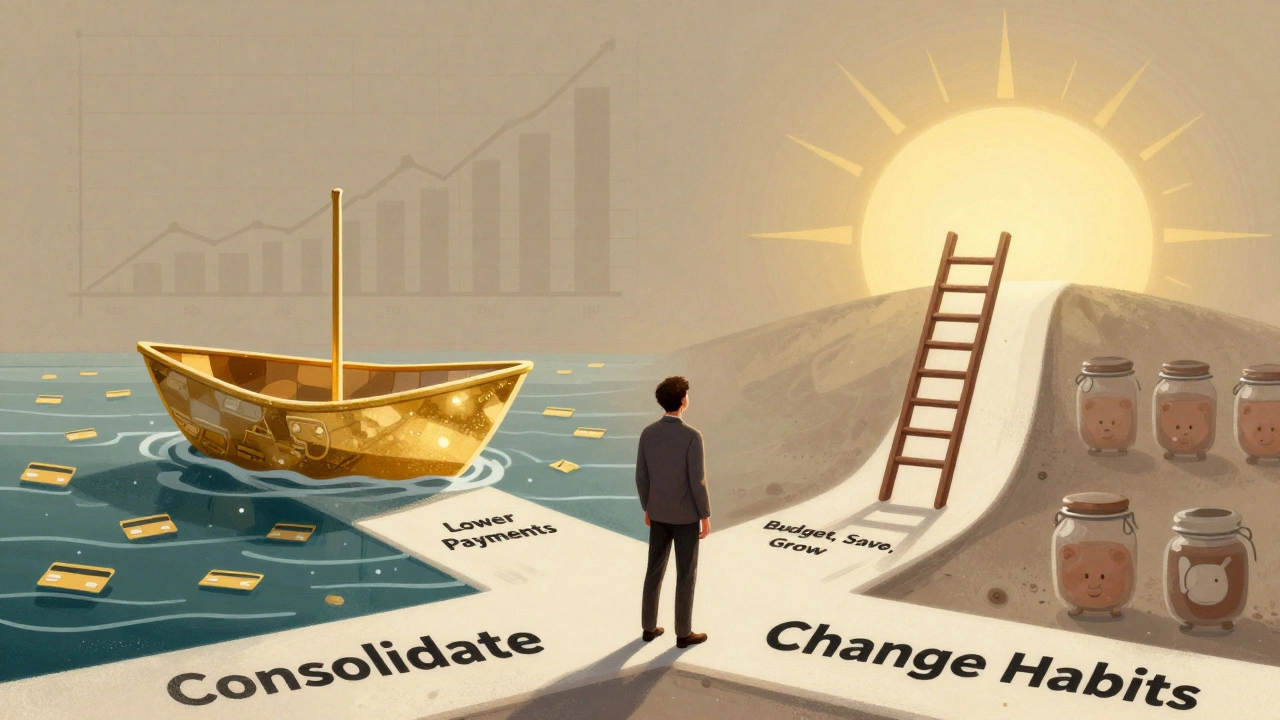
Consolidation only works if you change your habits
Here’s the brutal truth: consolidation doesn’t make you better with money. It just rearranges the deck chairs on the Titanic.
Studies from the Australian Securities and Investments Commission (ASIC) show that 68% of people who consolidate credit card debt end up with more debt within two years. Why? Because they kept using their old cards. They thought the loan was a “reset.” It wasn’t. It was a loan with a new name.
Successful consolidation has three non-negotiable rules:
- Cut up the cards. If you’re consolidating credit card debt, close the accounts. Or freeze them. Don’t leave them lying around.
- Build a budget that leaves no room for surprises. Track every dollar for at least three months. Use a free app like MoneyBrilliant or the one built into your bank app.
- Set up an emergency fund - even if it’s $50 a month. One unexpected bill shouldn’t send you back to the credit card.
People who stick to these rules? Their debt drops by an average of 40% in 18 months. People who don’t? They’re back where they started - or worse.
When consolidation is a trap
Not every consolidation offer is honest. Some lenders push you into longer-term loans to make your monthly payment look smaller. But that means you pay more in interest over time.
Example: You have $30,000 in credit card debt at 20% interest. You consolidate into a 7-year personal loan at 9%. Your monthly payment drops from $750 to $480. Sounds great, right? But over seven years, you pay $4,800 in extra interest compared to paying it off in three years. You saved cash flow - but you paid more overall.
Also, watch out for fees. Some lenders charge upfront fees of 3-5%. That’s $1,500 on a $30,000 loan. That’s not a discount - that’s a tax on your desperation.
And don’t fall for “debt settlement” companies that promise to slash your debt by 60%. These are often scams. They tell you to stop paying your bills. That tanks your credit score. Then they take a cut of whatever they manage to negotiate - if they negotiate anything at all.
What to do instead of guessing
If you’re wondering whether your debt is too much to consolidate, follow this simple flow:
- Calculate your DTI. If it’s above 40%, skip the easy loan route.
- Write down every debt - balance, interest rate, minimum payment.
- Use a free debt calculator (like ASIC’s MoneySmart tool) to compare payoff timelines.
- Ask yourself: “If I didn’t have this loan, would I still be spending like this?”
- If the answer is yes, fix your spending first. Then think about consolidation.
There’s no point in lowering your monthly payment if you’re still spending $1,200 a month on dining out, subscriptions, and impulse buys. That’s not a debt problem. That’s a spending problem.
When consolidation makes sense
It’s not about how much you owe. It’s about how you got there - and what you’ll do next.
Consolidation works best when:
- You have a stable income and a clear plan to stop accumulating debt.
- You’re paying high interest rates on multiple accounts (like credit cards at 20%+).
- You can get a lower interest rate - at least 3-5% lower - and shorten your payoff timeline.
- You’re willing to close old accounts and live within a budget.
For example, if you’ve got $25,000 in credit card debt at 21% interest and you qualify for a 9.5% consolidation loan with a 5-year term, you’ll pay $6,700 in interest total. If you kept paying minimums on the cards, you’d pay over $20,000 in interest - and it would take you 18 years to pay off.
That’s not just savings. That’s freedom.
Final reality check
Debt consolidation isn’t a miracle. It’s a tool. And like any tool, it can help you build - or destroy.
If you’re drowning because you keep spending beyond your means, consolidation won’t save you. It’ll just give you a bigger boat… and the same leak.
But if you’re drowning because you got hit with medical bills, lost your job for six months, or had a family emergency - and now you’re just trying to get back on track - then consolidation can be the lifeline you need.
Ask yourself: Am I trying to fix my finances - or just my payments?
If it’s the first - you’re ready.
If it’s the second - you need to stop. And start over.
Can I consolidate debt if I have bad credit?
Yes, but your options are limited. You might qualify for a secured loan using your car or home as collateral. Some lenders specialize in bad credit consolidation, but expect higher interest rates - often over 15%. Your best bet is a debt management plan through a nonprofit like Financial Counselling Australia. They don’t require good credit and can negotiate lower rates with your creditors.
Will consolidating debt hurt my credit score?
It might dip slightly at first - especially if you close old accounts or open a new loan. But if you make on-time payments and reduce your overall debt, your score will recover and usually improve within 6-12 months. The bigger risk is continuing to use your old credit cards - that’s what really tanks your score.
Is it better to consolidate with a personal loan or a home equity loan?
A personal loan is safer if you don’t want to risk your home. Interest rates are higher, but you won’t lose your house if you miss a payment. A home equity loan has lower rates, but it’s secured by your property. Only choose this if you’re confident in your income and have a solid plan to pay it off. If your income is unstable, go with the unsecured personal loan.
How long does debt consolidation take to work?
It’s not a quick fix. You’ll see lower monthly payments right away. But real progress - paying off the debt and rebuilding your finances - takes 2-5 years. The key isn’t the loan term. It’s whether you change your habits. People who track spending and avoid new debt usually become debt-free in under three years.
Should I consolidate my student loans with other debt?
Generally, no. Australian student loans (HECS-HELP) have no interest, are income-contingent, and only repay when you earn above $51,550 a year. Consolidating them into a personal loan means you’ll lose those protections and pay interest upfront. Keep them separate. Focus on high-interest debts first.
Next steps if you’re considering consolidation
Start here:
- Log into your bank and credit card apps. Write down every debt you have - even small ones.
- Use ASIC’s MoneySmart debt calculator to compare payoff scenarios.
- Call a free financial counsellor at 1800 007 007. They’ll help you understand your options without pressure.
- Don’t sign anything until you’ve compared at least three lenders. Watch for hidden fees.
- Before you take the loan, close or freeze your old credit cards. Then set up automatic transfers to pay the new loan on time.
Debt consolidation isn’t the end of your financial journey. It’s the beginning of a harder, smarter one. The question isn’t how much you owe. It’s whether you’re ready to change.