Savings Calculator: Weekly Contributions
Calculate Your Savings
How It Works
Based on Australian high-interest savings accounts with monthly compounding. Calculates your savings after 52 weeks × years of consistent weekly deposits.
Without interest: $0.00
With interest: $0.00
Interest earned: $0.00
Your Savings Growth
| Year | Without Interest | With 5% Interest |
|---|---|---|
| 1 | $1,040.00 | $1,067.00 |
| 3 | $3,120.00 | $3,285.00 |
| 5 | $5,200.00 | $5,567.00 |
| 10 | $10,400.00 | $12,148.00 |
The article shows that consistent savings grow faster than expected due to compound interest. Even small amounts add up over time!
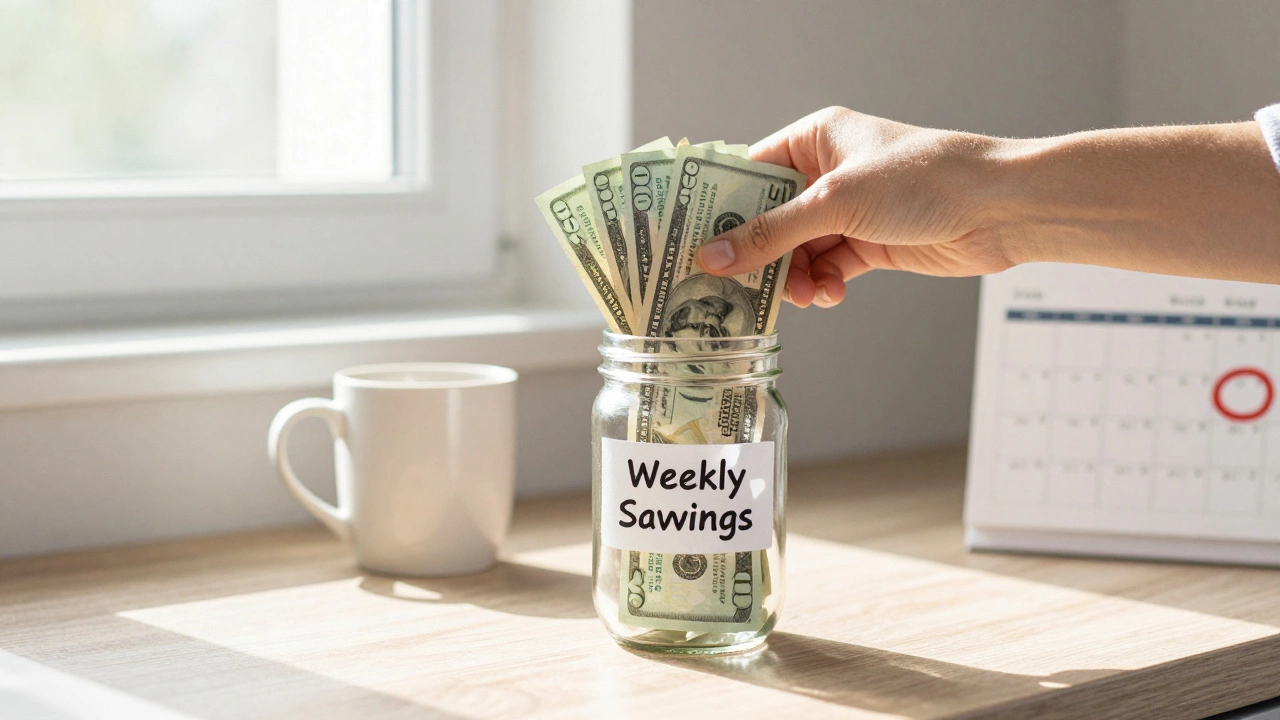
If you save $20 every week for a year, you’ll end up with $1,040 before any interest. That’s it-no magic, no complicated math. Just $20 set aside each week, like clockwork. No fancy apps, no side hustles. Just putting cash aside and letting it sit. Sounds simple? It is. And that’s exactly why it works.
How $20 a Week Adds Up
Let’s break it down. There are 52 weeks in a year. Multiply $20 by 52, and you get $1,040. That’s the base number. No bank, no interest, no guesswork. This is pure, untouched savings. You could stash it under your mattress, in a jar, or in a basic savings account-it doesn’t change the total. But here’s where things get interesting: where you put that money matters.
Most people think saving $20 a week won’t make a difference. But $1,040 is enough to cover a major car repair, pay off a credit card balance, or fund a short vacation without going into debt. It’s not life-changing money, but it’s life-improving money. And it’s money you didn’t even notice you were missing.
Where to Keep Your $20 a Week Savings
Keeping cash at home feels safe, but it’s not smart. Inflation eats away at purchasing power. If you’re not earning any interest, your $1,040 in 2026 will buy less in 2027. That’s why putting it in a savings account is the first real upgrade.
In Australia, high-interest savings accounts (HISAs) are common. As of early 2026, top-tier accounts are offering between 4.5% and 5.5% p.a. interest, especially if you meet basic conditions like making regular deposits and not withdrawing. Let’s say you get 5% interest, compounded monthly. That’s not just $1,040 anymore.
With $20 deposited weekly into a 5% p.a. savings account, you’ll end up with about $1,067 by year’s end. That’s $27 extra, just for letting the bank hold your money. It’s not a fortune, but it’s free money-money you didn’t have to work harder for. And if you keep this up year after year, the compounding effect grows.
What Happens If You Keep Going?
One year of $20 a week gives you $1,067. What about five years? Ten? If you keep saving $20 a week and earn 5% interest annually, here’s what you’ll have:
- After 1 year: $1,067
- After 3 years: $3,285
- After 5 years: $5,567
- After 10 years: $12,148
That’s not a retirement fund, but it’s a solid emergency stash. Enough to cover six months of basic living costs if you lose your job. Or enough to pay for a new laptop, dental work, or a family trip without touching your credit card. And the longer you do it, the more the interest builds on top of your own contributions.

Why This Works Better Than You Think
Saving $20 a week isn’t about the amount. It’s about the habit. People who save small, consistent amounts are more likely to stick with it than those who try to save $500 a month and burn out after two weeks. $20 is easy to find. It’s the cost of one takeaway coffee a week. Or skipping one online subscription. Or buying generic brands instead of name brands.
It’s also psychologically easier. You don’t feel like you’re missing out. You’re not cutting back on essentials-you’re just shifting one small expense into a future safety net. That’s why this method is used by financial coaches all over Australia. It’s not flashy, but it’s reliable.
What If You Can Save More?
If $20 feels too low, start there anyway. Then, after a month, bump it up to $25. Then $30. Small increases compound over time. If you save $30 a week instead of $20, you’ll have $1,560 in a year-$520 more. At 5% interest, that’s $1,594. In five years? Over $8,300. That’s not just a cushion. That’s a launchpad.
And if you can save $50 a week? You’re looking at $2,600 a year. In five years, with interest, you’ll have over $14,000. That’s enough to replace your car, pay for a certification course, or put a down payment on a small investment property.
Common Mistakes People Make
Even with a simple plan like this, people mess it up. Here’s what goes wrong:
- Putting it in a low-interest account - Many banks still offer savings accounts with 0.5% interest. That’s barely better than zero. Shop around. Use comparison sites like Canstar or RateCity to find the best rates.
- Withdrawing too often - If you dip into your savings every time you see a sale, you’re not saving. Set up automatic transfers so the money leaves your checking account before you even think about spending it.
- Waiting for the “right time” - There’s no perfect time to start. Today is the best day. If you wait until your paycheck is bigger or your bills are lower, you’ll never start.
Another big mistake: thinking you need to save more to make a difference. You don’t. You just need to save consistently. $20 a week is enough to build momentum. Momentum leads to confidence. Confidence leads to bigger goals.

Real-Life Example: Maria from Brisbane
Maria works part-time at a café. She earns $600 a week after tax. She used to spend $25 a week on coffee and snacks during her shifts. One day, she decided to cut that back to $5 and put the other $20 into a high-interest savings account. She didn’t even notice the difference in her daily life. After six months, she had $1,200 saved. She used it to fix her car. No loan. No stress. Just cash in the bank.
Now, two years later, she’s saving $35 a week. She’s got $3,500 saved. She’s planning to take a trip to the Gold Coast next year. All because she started with $20 a week.
How to Make It Stick
Here’s how to turn $20 a week into a habit:
- Open a separate savings account. Don’t use your everyday account.
- Set up an automatic transfer every Friday. $20 from your pay into savings.
- Label the account something motivational: "Car Fund," "Emergency Cash," "Future Trip."
- Don’t touch it unless it’s a true emergency.
- Review it every three months. Celebrate small wins.
That’s it. No apps needed. No budgeting software. Just a bank account and discipline.
What’s Next After One Year?
When you hit $1,040-or $1,067 with interest-don’t stop. Ask yourself: What’s the next goal? A new phone? A holiday? A bigger emergency fund? Use the same system. Keep saving $20 a week, or increase it. Build on what you’ve already done.
Most people who save this way end up saving more without even trying. Once you see the balance grow, it becomes addictive. You start noticing other places to cut back. You feel more in control. And that’s the real win.
How much will I have if I save $20 a week for a year without interest?
You’ll have exactly $1,040. That’s $20 multiplied by 52 weeks. No interest, no extra growth-just pure savings.
Can I earn interest on $20 a week savings?
Yes. If you put your weekly savings into a high-interest savings account with a 5% annual interest rate, you’ll earn about $27 in interest over a year. That brings your total to $1,067. The more you save over time, the more interest compounds.
Is $20 a week too little to bother saving?
No. $20 a week is enough to build a habit. Many people who end up saving thousands started with just $10 or $20. The real power isn’t in the amount-it’s in consistency. Saving small amounts regularly is more effective than saving big amounts sporadically.
What’s the best type of account for weekly savings in Australia?
A high-interest savings account (HISA) is best. Look for accounts with no monthly fees, at least 4.5% p.a. interest, and automatic transfers. Banks like ING, UBank, and ME Bank often offer competitive rates. Avoid basic savings accounts that pay less than 1%.
Should I save $20 a week or $80 a month?
It’s the same amount-$20 a week equals $80 a month. Weekly deposits can help you stay on track better because they align with pay cycles. If you get paid weekly, saving $20 each payday makes it easier to remember and harder to skip.