

Pension Risk Assessment Tool
Accumulation Phase Risks
Decumulation Phase Risks
| Metric | Value | Status |
|---|
Imagine waking up on your first day of retirement, only to realize your savings have shrunk by 20% in the last six months. It’s a nightmare scenario for many, but it happens more often than we’d like to admit. The question isn’t just pension risk, but how much of that risk you can actually stomach when you no longer have decades to recover from a bad market year.
When people ask if a pension is risky, they are usually conflating two very different things: the risk of losing money while you are saving, and the risk of running out of money once you start spending it. These are distinct phases with different dynamics. Understanding this distinction is the first step toward securing your future.
The Two Faces of Pension Risk
To understand the danger zones, we need to split your pension journey into two acts. Act One is the accumulation phase, where you are working and contributing. Act Two is the decumulation phase, where you are retired and withdrawing funds. Each has its own unique set of threats.
During accumulation, the primary enemy is Market Volatility is the fluctuation of asset prices over time, which can cause significant short-term losses in value. If you invest aggressively in growth assets like equities, you will see your balance swing wildly. However, because you have time on your side, these dips are usually temporary. The real danger here is behavioral: panic selling during a crash locks in those losses permanently.
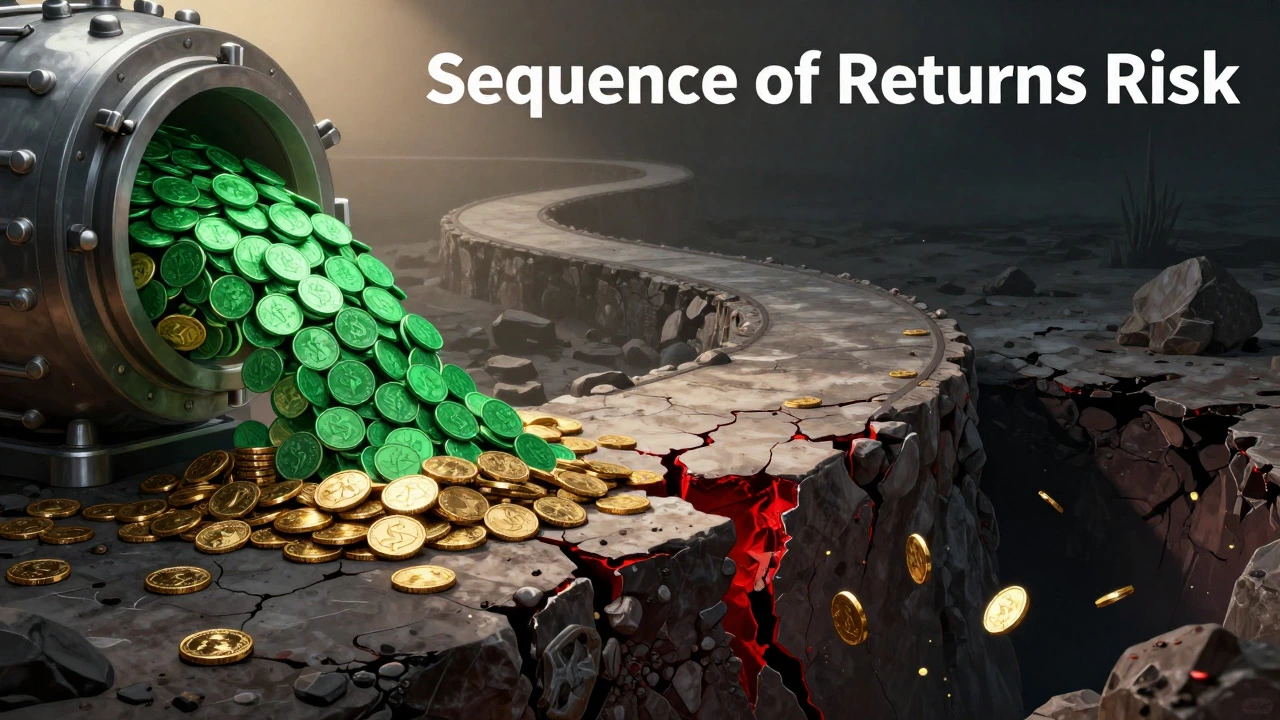
In the decumulation phase, the risks shift. You are now exposed to Sequence of Returns Risk is the risk that poor investment returns occur early in retirement, depleting capital faster than expected. This is arguably the most dangerous type of pension risk. If the market drops 30% in your first year of retirement, and you continue to withdraw your planned income, you must sell shares at their lowest points. This drastically reduces your remaining capital, making it nearly impossible to recover even if the market bounces back later.
Why Inflation Is the Silent Killer
Most people focus on stock market crashes, but there is a quieter, more persistent threat: Inflation is the rate at which the general level of prices for goods and services is rising, eroding purchasing power. In Australia, the Consumer Price Index (CPI) has historically averaged around 2-3% per year. That sounds small, but over a 20-year retirement, it compounds significantly.
If you plan to spend $60,000 a year today, maintaining that same standard of living requires roughly $90,000 a year in twenty years’ dollars. If your pension fund grows slower than inflation, you are effectively poorer every single year, even if the nominal value of your account stays flat. This is why holding too much cash or low-yield bonds can be just as risky as holding too much equity. Cash provides safety from volatility, but it offers almost no protection against the erosion of buying power.
Longevity Risk: Living Longer Than Your Money
We live longer than our grandparents did. In Australia, life expectancy continues to rise, meaning the probability of living into your late 80s or even 90s is higher than ever before. This creates Longevity Risk is the risk that an individual will outlive their financial resources due to increased life expectancy.
This risk hits hardest with self-managed superannuation funds or personal savings accounts. Unlike a defined benefit pension scheme (which is less common now but still exists for some public sector workers), a personal account does not guarantee payments for life. If you die at 75, your partner might inherit the rest. But if you both live to 95, you may find yourself dipping into principal reserves that were meant to last until 85.
To mitigate this, many retirees consider converting a portion of their super into an Annuity is a financial product that provides a fixed stream of income for a specified period or for life. By locking in a guaranteed income floor, you remove the uncertainty of how long your variable investments will last. It’s a trade-off: you give up potential upside in exchange for certainty.
Comparing Risk Profiles: Accumulation vs. Decumulation
It helps to visualize how these risks change as you age. The table below breaks down the primary threats at each stage of your financial life.
| Risk Factor | Accumulation Phase (Working) | Decumulation Phase (Retired) | Mitigation Strategy |
|---|---|---|---|
| Market Volatility | High tolerance needed; time allows recovery | Low tolerance; no time to recover large drops | Shift asset allocation towards bonds/cash as retirement approaches |
| Inflation | Managed by salary growth and investment returns | Directly erodes purchasing power of withdrawals | Maintain exposure to growth assets; use index-linked bonds |
| Longevity | Not yet relevant | Primary risk of outliving savings | Purchase annuities or maintain a conservative withdrawal rate |
| Sequence of Returns | Minimal impact | Critical impact on total portfolio survival | Hold a cash buffer (1-2 years of expenses) to avoid selling in downturns |
Strategies to Manage the Unmanageable
You cannot eliminate pension risk entirely, but you can manage it. The most effective strategy is diversification across three dimensions: assets, geography, and time.
First, diversify your assets. Don’t put everything in Australian shares. Include international equities, global bonds, and perhaps a small allocation to alternative assets like infrastructure or real estate. This spreads the impact of any single market failure.
Second, consider the "Glide Path." As you approach retirement, gradually reduce your exposure to volatile assets. For example, if you are 40, you might hold 80% equities and 20% bonds. By age 60, you might shift to 50% equities and 50% bonds. This reduces the chance of a massive drop right before you need the money. However, don’t go 100% cash. You still need growth to fight inflation.
Third, build a cash buffer. Keep one to two years’ worth of living expenses in a high-interest savings account or term deposit. When the market crashes, you live off this cash instead of selling your investments at a loss. This simple tactic dramatically reduces sequence of returns risk.
The Role of Government Guarantees
In Australia, the system relies heavily on the Age Pension is a government-funded means-tested payment provided to eligible older Australians to supplement their income. While it is not designed to replace your entire lifestyle, it acts as a safety net. Because it is means-tested, having a large super balance can reduce or eliminate your eligibility. Some retirees strategically structure their finances to maximize their Age Pension entitlement while keeping enough super for lifestyle costs. This is complex and requires careful planning, but it adds another layer of security against extreme longevity risk.

Common Misconceptions About Safety
Many people believe that putting all their super into a "low-risk" option is the safest bet. In reality, this can be a trap. Low-risk options often consist of cash and short-term bonds. While they protect against market drops, they offer returns that barely keep pace with inflation. Over a 30-year retirement, a "safe" portfolio that loses 1% of its real value per year will leave you with only half your purchasing power by the end. True safety is not about avoiding volatility; it’s about ensuring your money lasts as long as you do.
Another misconception is that fees don’t matter much. In a long-term horizon, even a 0.5% difference in annual fees can cost tens of thousands of dollars by the time you retire. Fees compound negatively just as returns compound positively. Choosing lower-cost index funds or ETFs can significantly improve your final outcome without taking on extra risk.
Practical Steps to Assess Your Own Risk
So, how do you know if your current setup is safe? Start by running a stress test. Ask yourself: What happens if the market drops 30% next year? Can I cover my bills for two years without touching my investments? If the answer is no, you need a bigger cash buffer.
Next, calculate your sustainable withdrawal rate. A common rule of thumb is the 4% rule, suggesting you can withdraw 4% of your initial portfolio value annually, adjusted for inflation. However, given recent market conditions, some experts suggest a more conservative 3% to 3.5% rate to ensure longevity. Use online calculators to model different scenarios based on your actual balance and desired income.
Finally, review your insurance coverage. Do you have adequate health insurance? What about income protection if you work past 65? Unexpected medical bills can derail even the best pension plans. Ensuring you have robust health and life insurance reduces the shock of unexpected events.
Frequently Asked Questions
Is it safer to keep my pension in cash?
No, keeping everything in cash is rarely safe for a long retirement. While cash protects against short-term market drops, it suffers from inflation risk. Over 20-30 years, inflation will erode your purchasing power significantly. A balanced mix of growth assets and stable assets is generally safer for long-term security.
What is the biggest risk for retirees in Australia?
The biggest risk is typically longevity combined with sequence of returns. If you live a long life and experience a market crash in your first few years of retirement, your savings can deplete rapidly. Mitigating this requires a cash buffer and potentially purchasing an annuity for a guaranteed income floor.
How does inflation affect my superannuation balance?
Inflation reduces the real value of your money. If your super balance grows at 4% but inflation is 3%, your real wealth only grows by 1%. If your balance stays flat while inflation rises, you are effectively losing money. To combat this, your portfolio must include assets that historically outperform inflation, such as equities.
Should I buy an annuity to reduce risk?
An annuity can be a powerful tool for reducing longevity risk. By converting part of your super into an annuity, you lock in a guaranteed income for life. This ensures you have a baseline amount to cover essential expenses, regardless of what the markets do. It is particularly useful for covering fixed costs like housing and healthcare.
What is a good withdrawal rate for retirement?
The traditional guideline is 4% of your initial portfolio value in the first year, adjusted for inflation annually. However, many financial planners now recommend a range of 3% to 3.5% for greater safety, especially if you expect to live into your late 80s or 90s. The exact rate depends on your asset allocation and risk tolerance.