Debt Consolidation Calculator
Current Debt Overview
Consolidation Comparison
If you’re juggling multiple credit card bills, personal loans, and maybe even a medical bill or two, you’re not alone. Every month, you’re playing financial whack-a-mole-paying one, then another, then another-only to realize you’re still stuck in the same cycle. What if you could turn all those separate payments into just one? That’s the promise of debt consolidation, and it’s not magic. It’s a practical, proven way to simplify your finances and potentially save money.
What debt consolidation actually does
Debt consolidation isn’t about making your debt disappear. It’s about combining multiple debts into a single loan with one monthly payment. Think of it like merging several rivers into one stream. Instead of paying five different creditors with five different due dates, interest rates, and minimum payments, you pay one lender one amount, once a month.
The goal? Lower your monthly cash outflow, reduce the total interest you pay over time, and make it easier to stay on top of things. Many people use debt consolidation to get out of the trap of paying only the minimum on high-interest credit cards-where most of your payment goes to fees and interest, not the actual balance.
For example, if you’ve got $8,000 spread across three credit cards with rates between 19% and 24%, you could be paying over $150 a month just in interest. A debt consolidation loan at 10% could slash that interest cost in half-and give you a fixed payment you can plan around.
How to consolidate your debt: three main ways
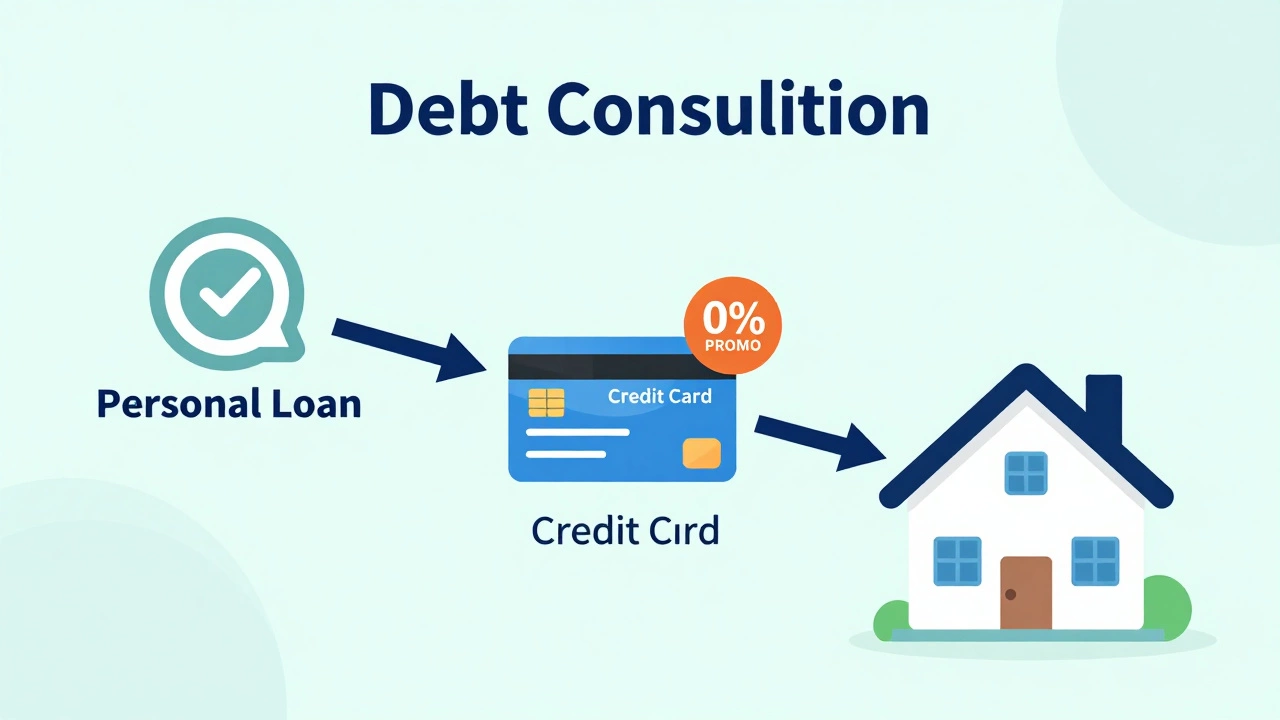
There are three common paths to combine your debts into one payment. Each has pros and cons, and your best choice depends on your credit score, income, and how much you owe.
1. Debt consolidation loan
This is the most straightforward method. You apply for a personal loan-unsecured, meaning no collateral-and use the money to pay off your existing debts. Then you repay the new loan in fixed monthly installments.
Best for: People with good credit (680+), steady income, and a clear plan to avoid new debt.
Typical rates in Australia (2025): 8% to 15% for borrowers with strong credit. Rates can go higher if your score is below 600.
Pros: Fixed payments, predictable timeline, often lower interest than credit cards.
Cons: You need decent credit to get a good rate. If you keep using your old cards after consolidating, you could end up with even more debt.
2. Balance transfer credit card
This option lets you move your existing credit card balances onto a new card that offers a 0% introductory interest rate-for 12 to 24 months. After that, the rate jumps, so you need to pay off the balance before the promo ends.
Best for: People who can pay off their debt within the intro period and have a credit score above 700.
Typical fees: 1% to 3% of the amount transferred. Some cards waive this fee for a limited time.
Pros: Can save hundreds-or thousands-in interest if you pay it off fast. No loan application needed.
Cons: If you don’t clear the balance before the promo ends, you’ll be hit with a high rate. Miss a payment, and you could lose the 0% offer entirely.
3. Home equity loan or line of credit (HELOC)
If you own a home, you can borrow against your home’s value. This is secured debt, meaning your house is collateral. Interest rates are usually lower because the lender has something to fall back on if you default.
Best for: Homeowners with equity, stable income, and the discipline to not use this as a cash machine.
Typical rates in 2025: 6% to 9% for fixed-rate home equity loans. HELOCs often have variable rates tied to the cash rate.
Pros: Lower interest than unsecured loans. Longer repayment terms (up to 20 years).
Cons: You’re putting your home at risk. If you can’t pay, you could lose it.
What you need before you start
Before you apply for any consolidation option, you need three things:
- A full list of your debts-including balances, interest rates, and minimum payments. Write them down. Don’t rely on memory.
- Your credit score-check it for free through your bank or via Equifax or Experian. If it’s below 600, your options will be limited, and rates will be high.
- A plan to stop borrowing-if you don’t close your old credit cards or change your spending habits, consolidation will just delay the problem.
One real example from Brisbane: Sarah, 34, had $12,000 in credit card debt across three cards. She was paying $420 a month in minimums, with over $200 going to interest each month. Her credit score was 695. She got a 10.5% personal loan for $12,000, paid off all her cards, and now pays $280 a month for 48 months. She saved $1,800 in interest and has one payment to remember.
Red flags to watch out for
Not every company offering debt consolidation is trustworthy. Watch for these warning signs:
- They ask for upfront fees before doing anything. Legitimate lenders don’t charge you until you get the money.
- They promise to eliminate your debt without paying it. That’s a scam.
- They pressure you to sign quickly or say you’re “pre-approved.” Real lenders give you time to review terms.
- They suggest you stop paying your creditors. That will wreck your credit score and could lead to legal action.
The Australian Securities and Investments Commission (ASIC) warns that debt relief scams cost Australians over $18 million a year. Stick with banks, credit unions, or licensed financial counsellors.
What happens after you consolidate
Consolidation isn’t the finish line-it’s the starting line. The real work begins after you pay off your old debts.
First, close the accounts you paid off. Don’t just cut up the cards-call the issuer and ask to close the account. This stops you from accidentally using them again.
Second, set up automatic payments for your new loan. Even one missed payment can cost you hundreds in late fees and higher interest.
Third, build a small emergency fund. Start with $500. It’s the buffer that keeps you from reaching for your credit card the next time your car needs fixing or the fridge breaks.
And finally, track your progress. Use a free budgeting app like Moneyhub or PocketGuard. Seeing your debt shrink month by month keeps you motivated.

When consolidation won’t help
Debt consolidation isn’t a fix for every situation. It won’t help if:
- Your income is unstable or too low to cover the new payment.
- You’re using credit cards to cover basic living costs-like rent or groceries. That’s a sign you need a budget, not a loan.
- You have more than $50,000 in unsecured debt. At that level, you may need to talk to a financial counsellor about debt agreements or bankruptcy.
If you’re overwhelmed, free help is available through the National Debt Helpline (1800 007 007). They work with accredited counsellors who can review your situation and suggest options tailored to you.
Final thought: One payment is just the beginning
Putting all your debt into one payment doesn’t make you rich. But it gives you breathing room. It gives you control. It turns chaos into clarity.
Thousands of people in Australia have done this. They didn’t win the lottery. They didn’t get a windfall. They just made one smart move-then stuck with it.
Start with your numbers. Check your credit. Compare your options. And don’t rush. The right consolidation plan is the one that fits your life-not the one that sounds the easiest.
Can I consolidate my debts if I have bad credit?
Yes, but your options are limited and more expensive. You might qualify for a secured loan, a loan with a co-signer, or a high-interest unsecured loan. Be cautious-higher rates can make your debt worse over time. Consider speaking with a free financial counsellor first. They can help you explore alternatives like a debt agreement or a payment plan with your creditors.
Will debt consolidation hurt my credit score?
It can, short-term. Applying for a new loan triggers a hard inquiry, which may drop your score by 5-10 points. Closing old credit cards can also lower your credit utilization ratio. But if you make on-time payments on your new loan, your score will typically recover within 6-12 months-and often ends up higher than before because your overall debt is lower.
Should I use a balance transfer card or a personal loan?
If you can pay off your debt in 12-18 months, a 0% balance transfer card is usually better because you pay no interest. If you need more than two years to pay it off, a personal loan is safer. Balance transfer cards often charge 18-24% after the promo ends, while personal loans lock in a fixed rate from day one.
Can I consolidate student loans with other debts?
In Australia, government student loans (HECS-HELP) cannot be consolidated with other debts. They have their own repayment system based on your income. Private student loans might be eligible, but it’s rarely a good idea. HECS-HELP has no interest, only indexation, and repayments only start when you earn over $51,550. Mixing it with high-interest debt can cost you more in the long run.
How do I know if I’m getting a good rate?
Compare the comparison rate, not just the advertised interest rate. The comparison rate includes fees and charges, so it gives you the true cost. For a personal loan, anything under 10% is strong for someone with good credit. Above 15% is expensive-look for alternatives. Always get quotes from at least three lenders before deciding.
If you’ve been drowning in multiple payments, now is the time to take action-not tomorrow, not next month. Start by writing down every debt you have. The first step to freedom is knowing exactly where you stand.