
Credit Card Debt Calculator
How Long Will It Take To Pay Off Your Debt?
See how your payment amount affects the total interest paid and time to pay off $5,000 credit card debt at 22% APR.
Repayment Results
Calculate your specific repayment plan by entering your payment amount above.
Credit Utilization Calculator
See how your credit utilization ratio affects your credit score.
Calculate your credit utilization ratio using the button above.
Is $5,000 in credit card debt a lot? The short answer: it depends. Not because the number itself is magical, but because of what’s behind it-your income, your interest rate, your other debts, and how fast you plan to pay it off. For some people, $5,000 is manageable. For others, it’s a crisis waiting to happen. Let’s cut through the noise and break down what this debt really means for your finances.
What $5,000 in Credit Card Debt Actually Looks Like
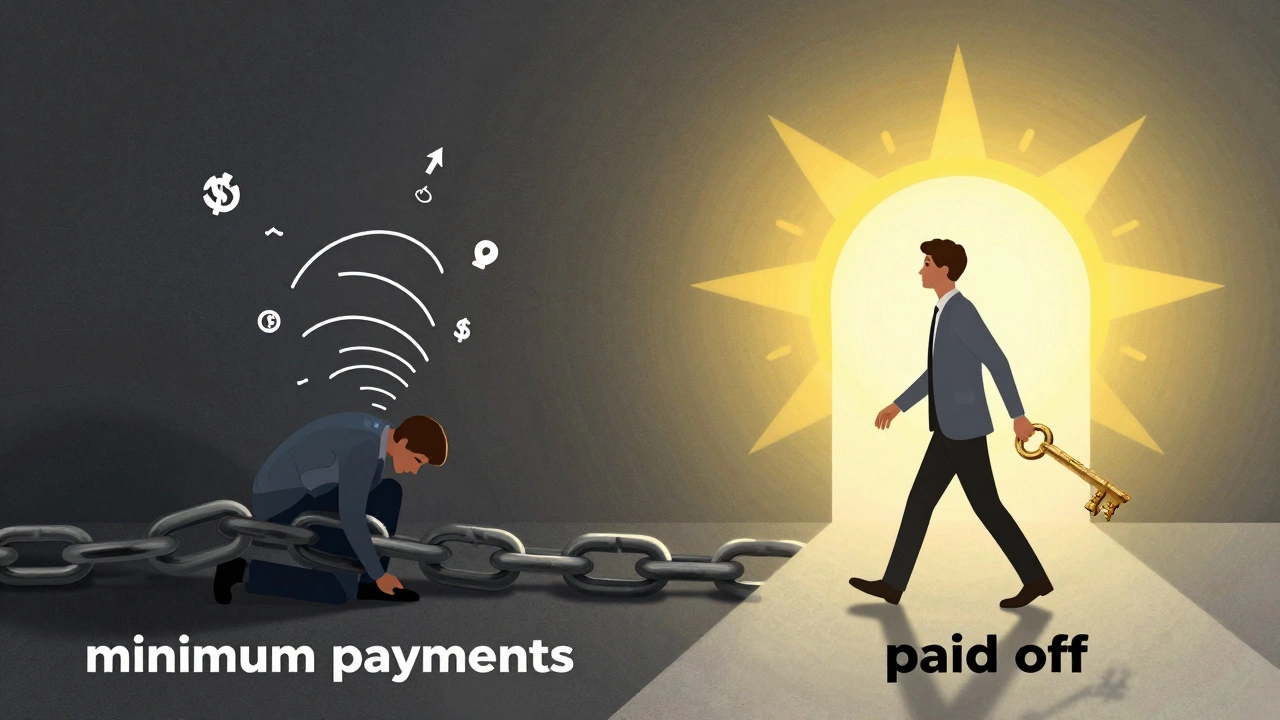
Let’s say you owe $5,000 on a credit card with a typical APR of 22%. That’s not unusual. The average U.S. credit card interest rate in early 2026 is still hovering around 21-23%. If you only make the minimum payment-usually 2-3% of the balance-you’ll be stuck paying for over 20 years. You’d end up paying nearly $7,000 in interest alone. That’s more than you originally borrowed.
Now, picture this: you pay $200 a month. At 22% APR, you’d clear the debt in about 31 months and pay around $1,700 in interest. Still not great, but way better than dragging it out. If you can bump that up to $300 a month? You’re done in 19 months with just $950 in interest. The difference between $200 and $300 isn’t just about time-it’s about thousands of dollars saved.
Is $5,000 a Lot Compared to Other Debts?
Compared to student loans or mortgages, $5,000 seems small. The average U.S. student loan balance is over $37,000. The average mortgage? Around $250,000. But credit card debt is different. It’s revolving. That means it doesn’t have a fixed term, and interest piles up fast. Unlike a car loan or personal loan, there’s no set end date unless you force one.
Also, credit card debt is the most expensive kind of debt you can carry. Personal loans for the same $5,000 might cost you 8-12% APR. Even a 0% balance transfer card (if you qualify) could give you 12-21 months to pay without interest. That’s why $5,000 on a credit card is more dangerous than $10,000 on a 6% auto loan.
Your Credit Score Is on the Line
Here’s something most people miss: your credit utilization ratio. This is the percentage of your available credit you’re using. If you have one card with a $5,000 limit and you owe $5,000, your utilization is 100%. That’s a red flag to lenders. Even if you pay on time, high utilization can drop your credit score by 50-100 points.
Let’s say you have two cards: one with a $5,000 limit and another with a $3,000 limit. Total credit limit: $8,000. You owe $5,000. That’s 62.5% utilization. Still too high. Experts say keeping utilization under 30% is smart. Under 10%? Even better. So $5,000 on a $50,000 limit? That’s 10%-fine. $5,000 on a $6,000 limit? That’s a disaster waiting to happen.
How Much Income Do You Need to Handle This?
There’s no magic number, but here’s a rule of thumb: if your monthly credit card payments (minimum or planned) are more than 10% of your take-home pay, you’re in danger. Let’s say you make $4,000 a month after taxes. Paying $400 a month toward $5,000 in debt? That’s doable. Paying $500? Still okay, but tight.
Now imagine you make $2,500 a month. $400 a month is 16% of your income. That’s a lot. It leaves less for rent, groceries, emergencies, or savings. That’s when $5,000 stops being a "balance" and starts being a trap.
What’s the Best Way to Get Out of $5,000 in Credit Card Debt?
You’ve got options. Here’s what actually works:
- Balance transfer to a 0% APR card-If you have good credit (670+), you can often find a card offering 12-21 months at 0% interest. You’ll pay a 3-5% transfer fee, but that’s still cheaper than ongoing interest. Example: $5,000 transfer fee = $150-$250. Paying it off in 18 months = $0 interest. You save $1,500+.
- Debt consolidation loan-Get a personal loan at 8-12% APR and pay off the card. Monthly payments become fixed. You’ll know exactly when you’re done. This works best if your credit score is above 640.
- Debt management plan-Through a nonprofit credit counseling agency, you can get your interest rate lowered and pay one monthly payment. These agencies often negotiate rates down to 6-9%. They also freeze new charges. This is ideal if you’re struggling to make minimums.
- Do-it-yourself snowball or avalanche method-Snowball: pay off the smallest balance first for quick wins. Avalanche: pay off the highest interest rate first to save money. Avalanche saves more. Snowball keeps you motivated. Pick based on your psychology.
What Happens If You Do Nothing?
Ignoring $5,000 in credit card debt doesn’t make it disappear. It grows. Late payments hit your credit report after 30 days. After 180 days, the issuer will charge it off. That’s when collection agencies jump in. They’ll call, send letters, and eventually sue you. A judgment can lead to wage garnishment or bank levies.
And your credit score? It’ll tank. A single missed payment can drop your score 100+ points. A charge-off? That stays on your report for seven years. Even if you pay it later, it still shows as "charged off." That means higher interest rates on future loans, denied apartments, or even job rejections in some industries.
When $5,000 Is Actually Manageable
It’s not all doom. If you’re earning $75,000+ a year, have no other debt, and have an emergency fund, $5,000 is just a speed bump. Pay it off in six months. No drama. You might even be able to use a balance transfer card to cut interest to zero and pay it off without penalty.
Or if you’re in a temporary hardship-job loss, medical issue, family emergency-and you know you’ll be back on track in 3-6 months, then $5,000 is a pause, not a failure. Talk to your issuer. Many offer hardship programs: reduced payments, deferred interest, or temporary pauses.
Final Reality Check
$5,000 in credit card debt isn’t a number. It’s a symptom. It’s a sign that spending habits, income gaps, or financial planning need adjustment. It’s not the end of the world. But it’s not harmless either.
Ask yourself:
- Can I pay more than the minimum?
- Do I have other high-interest debt?
- Is my credit utilization above 50%?
- Am I still using this card to spend?
If you answered yes to any of those, you’re at risk. The sooner you act, the less you’ll pay. And the faster you’ll get your financial freedom back.