Bitcoin Investment Simulator
Investment Parameters
Results & Analysis
Adjust parameters and click Calculate to see your potential returns.
You’ve got a spare $100 burning a hole in your pocket. It’s not enough to buy a house, and it’s barely enough for a decent dinner out with friends. But what if you threw that hundred bucks into Bitcoin, the world’s most famous cryptocurrency? Is it a lottery ticket? A waste of time? Or the seed of a future fortune? Since we are now deep into mid-2026, the landscape has shifted significantly from the wild west days of earlier years. The answer isn’t simple, but it is calculable.
The Immediate Reality: Fees and Fragmentation
Let’s be brutally honest right out of the gate. When you invest $100 in Bitcoin today, the first thing that happens is you lose a slice of it to fees. This is the unglamorous truth of small-scale crypto investing. Most exchanges charge a spread (the difference between the buy and sell price) plus a transaction fee. If you use a major platform like Coinbase or Binance, you might see anywhere from $1 to $5 vanish instantly depending on whether you pay via bank transfer or credit card.
So, that $100 doesn’t buy you $100 worth of Bitcoin. It buys you maybe $95 to $98 worth. In percentage terms, that’s a 2% to 5% immediate loss. For large investors moving millions, this is negligible. For a $100 starter amount, it’s a significant headwind. You need Bitcoin to rise by at least that much just to break even. This is why many seasoned traders advise against micro-investing on high-fee platforms unless you’re using zero-fee tiers or specific discount brokers.
The Volatility Factor: Sleepless Nights or Exciting Swings?
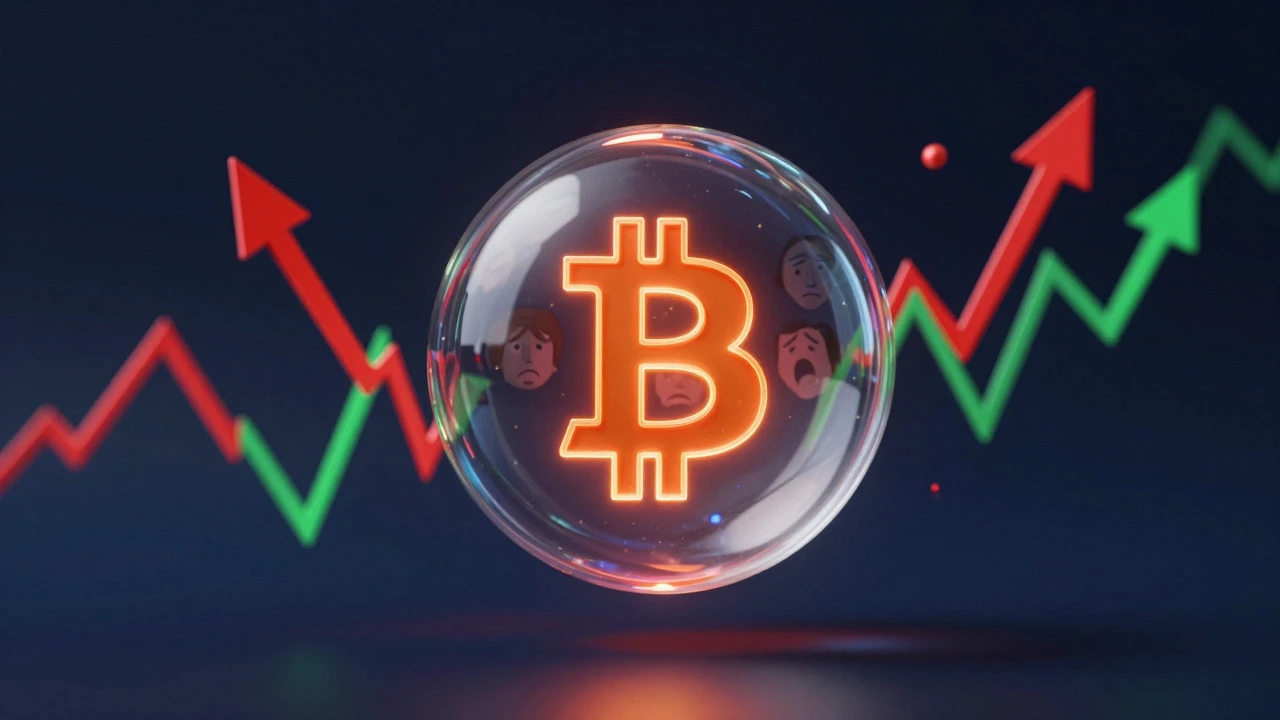
Bitcoin is notorious for its volatility. Even in 2026, after years of institutional adoption, it remains far more volatile than stocks or bonds. One week, your $100 could be worth $115. The next, it could drop to $85. This isn’t a bug; it’s a feature of an asset class that is still maturing.
If you are the type of person who checks their portfolio every hour, $100 might feel safer because the absolute dollar swings are small. Losing $10 feels less painful than losing $1,000. However, psychologically, the percentage loss is identical. The risk here isn’t financial ruin-it’s emotional fatigue. Will you panic-sell when the market dips 10%? Or will you hold steady? With only $100 on the line, the stakes are low enough to teach you how you react to market stress without jeopardizing your rent money.
| Timeframe | Best Case Scenario | Worst Case Scenario | Most Likely Outcome |
|---|---|---|---|
| 1 Month | $130 (+30%) | $70 (-30%) | High volatility, likely flat or slight gain/loss |
| 1 Year | $250 (+150%) | $40 (-60%) | Moderate growth aligned with broader crypto cycles |
| 5 Years | $1,000 (+900%) | $20 (-80%) | Significant appreciation due to halving cycles and adoption |
The Power of Dollar-Cost Averaging (DCA)
Here is where the real magic happens. Investing $100 once is a one-time bet. Investing $100 *every month* is a strategy. This approach is called Dollar-Cost Averaging, or DCA. Instead of trying to time the market-which even professionals fail at-you buy a fixed dollar amount at regular intervals.
Imagine you invest $100 in Bitcoin every month for a year. Some months, Bitcoin is expensive, so you get less coin. Other months, it’s cheap, so you get more. Over time, this smooths out your average entry price. You stop worrying about whether today is the “right day” to buy. You just show up. In the context of 2026, where regulatory clarity has improved in many regions including Australia and the US, DCA has become the standard advice for retail investors. It removes emotion and builds discipline.
Tax Implications: The Hidden Cost
Don’t forget the tax man. In most jurisdictions, including Australia, selling Bitcoin for a profit triggers Capital Gains Tax (CGT). If you buy $100 worth of Bitcoin and sell it for $120, that $20 profit is taxable income. Now, most tax authorities have thresholds for small gains, but if you trade frequently, these small amounts add up.
Furthermore, record-keeping becomes a nightmare with small transactions. Tracking the exact cost basis of tiny fractions of Bitcoin across multiple purchases can be tedious. Using software tools that automatically track crypto transactions is almost essential if you plan to keep this up long-term. Ignoring this step could lead to penalties later, turning a small win into an administrative headache.
Security: Protecting Your Digital Asset
When you invest $100, you might think, “Who would hack me?” Think again. Cybercriminals don’t discriminate based on balance size. They automate attacks. If you leave your Bitcoin on an exchange, you are subject to the security risks of that platform. While major exchanges are insured and secure, history shows they are not immune to hacks or operational failures.
For larger amounts, buying a hardware wallet (like Ledger or Trezor) is non-negotiable. For $100, it might seem overkill to spend $50-$100 on a wallet. So, what do you do? Many beginners keep small amounts on reputable, regulated exchanges. As your portfolio grows past $1,000 or $2,000, migrating to self-custody becomes a priority. Until then, ensure two-factor authentication (2FA) is enabled on your exchange account. Use an authenticator app, not SMS, which is vulnerable to SIM-swapping attacks.

Opportunity Cost: What Else Could That 0 Do?
Every dollar invested in Bitcoin is a dollar not invested elsewhere. In 2026, high-yield savings accounts and government bonds offer stable, albeit lower, returns. A diversified stock index fund might provide steady 7-10% annual returns historically. Bitcoin offers the potential for much higher returns, but with much higher risk.
Ask yourself: What is this $100 doing in your financial life? Is it emergency fund money? If so, keep it in cash. Is it money you won’t touch for five years? Then Bitcoin makes sense as a speculative allocation. Financial advisors often suggest limiting crypto to 1-5% of your total net worth. If your total net worth is $10,000, then $100 to $500 in Bitcoin fits perfectly within that guideline.
The Psychological Win: Learning by Doing
Perhaps the biggest benefit of investing $100 in Bitcoin isn’t the money itself-it’s the education. Crypto can be confusing. Wallets, private keys, gas fees, networks, and market cycles are steep learning curves. By putting skin in the game, even a small amount, you force yourself to learn. You start reading news, understanding market trends, and grasping the technology behind blockchain.
This knowledge is invaluable. When the next bull run comes-and historical patterns suggest another cycle is inevitable-you’ll be prepared to act confidently rather than reacting emotionally. That $100 is tuition for a crash course in digital finance. If you treat it as such, you’ve already made a profit, regardless of the price action.
Is $100 enough to start investing in Bitcoin?
Yes, absolutely. Most modern exchanges allow you to buy Bitcoin with as little as $10 or even less. While fees may eat into smaller amounts, $100 is a perfect starting point to learn the ropes without significant financial risk.
Should I buy all $100 at once or split it up?
Splitting it up is generally safer. Consider buying $25 a week for four weeks. This averages out your purchase price and reduces the risk of buying right before a dip. This strategy is known as Dollar-Cost Averaging (DCA).
Will I lose all my money if Bitcoin crashes?
While Bitcoin is volatile, it has historically recovered from major crashes. However, no investment is guaranteed. Only invest money you can afford to lose. In 2026, with increased institutional stability, the risk of total collapse is lower than in previous years, but short-term losses are still common.
Do I need to pay taxes on my $100 Bitcoin investment?
You typically only pay taxes when you sell Bitcoin for a profit. If you hold onto it, you usually don’t owe capital gains tax. However, rules vary by country. In Australia, for example, any profit from selling crypto is subject to Capital Gains Tax. Keep records of your transactions.
Where should I store my Bitcoin safely?
For small amounts like $100, keeping it on a reputable, regulated exchange is acceptable. As your investment grows, consider moving it to a hardware wallet for better security. Always enable two-factor authentication (2FA) on your exchange account.