

US Citizen ISA Tax Calculator
How US Tax Law Affects Your ISA
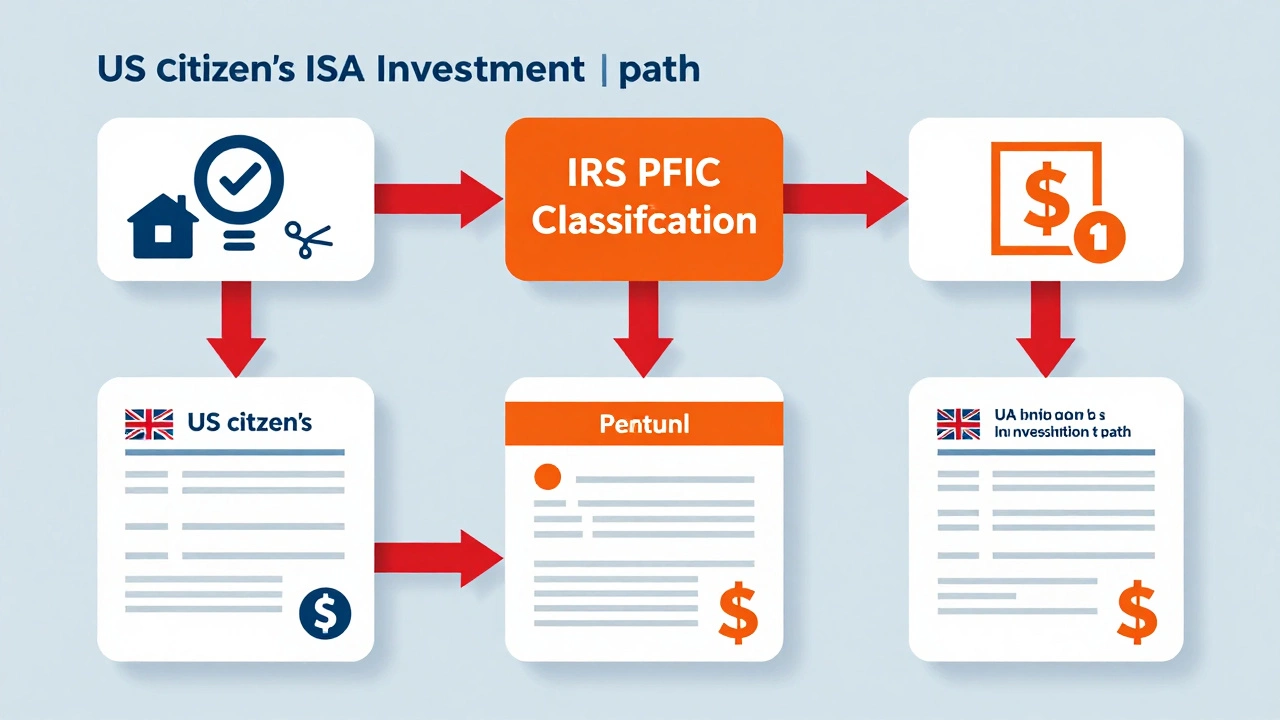
US citizens must pay tax on worldwide income. ISAs are treated as Passive Foreign Investment Companies (PFICs), subject to harsh tax rules and mandatory annual reporting. This tool estimates your potential tax liability and penalties.
PFIC Rules Apply
- US taxes all gains at ordinary income rates (up to 37%)
- Must file Form 8621 annually
- Failure to file = $10,000 penalty per form
- Unrealized gains are taxable
If you're a US citizen living in the UK-or thinking about moving there-you've probably heard about ISAs. They’re one of the most popular ways to save and invest in Britain, offering tax-free growth on everything from cash to stocks. But here’s the big question: Can a US citizen invest in an ISA? The short answer is yes, but with serious catches that could cost you more than you save.
What Is an ISA?
An ISA, or Individual Savings Account, is a UK government-backed savings or investment account that lets you earn interest, dividends, or capital gains without paying UK tax. There are different types: Cash ISA, Stocks and Shares ISA, Innovative Finance ISA, and Lifetime ISA. Each has its own rules, but they all share one key feature: tax-free growth.
For the 2025/2026 tax year, you can put up to £20,000 into ISAs total. That money grows without UK income tax, capital gains tax, or dividend tax. It’s a powerful tool-if you’re eligible.
Who Can Open an ISA?
To open an ISA, you must be:
- A UK resident for tax purposes
- At least 16 years old (for Cash ISA) or 18 (for Stocks and Shares ISA)
- Not already using your ISA allowance for the year
Residency matters more than citizenship. So if you’re a US citizen living in the UK and paying UK taxes, you can open an ISA. But if you’re living in the US and just visiting London for a month? No-you can’t open one.
The Big Problem: US Tax Law
Here’s where things get messy. The US taxes its citizens on worldwide income-no matter where they live. The IRS doesn’t recognize ISAs as tax-free accounts. To them, an ISA is just another investment account. That means:
- Any interest earned in a Cash ISA is taxable income
- Dividends from a Stocks and Shares ISA count as taxable income
- Capital gains inside the ISA are taxed when you sell
And it gets worse. The IRS treats most ISAs as Passive Foreign Investment Companies (PFICs). That’s a special category for foreign mutual funds and investment vehicles. PFICs come with brutal tax rules: you’re taxed at the highest ordinary income rate, even on unrealized gains, and you have to file Form 8621 every year. Failing to file can trigger penalties of $10,000 per form.
Real people have paid thousands in back taxes and penalties because they didn’t know their ISA was a PFIC. One client in London, a US citizen working for a tech startup, found out after filing his taxes in 2024 that his £15,000 ISA had triggered $4,200 in unexpected US tax and $1,800 in penalties.
What About the US-UK Tax Treaty?
You might think the US-UK tax treaty protects you. It doesn’t. The treaty doesn’t recognize ISAs as tax-advantaged accounts. The IRS explicitly says so in its guidance. Even if you’re covered by the treaty for pensions or social security, your ISA is still treated as a regular investment.
There’s no special exemption for ISAs under Article 18 (Pensions) or Article 10 (Dividends). The treaty simply doesn’t cover them. So you can’t rely on it to avoid the PFIC mess.
Can You Keep an ISA If You Move Back to the US?
Yes, you can keep your ISA open if you move back to the US. But you can’t add more money to it. Once you’re no longer a UK tax resident, your ISA becomes a ‘frozen’ account. You can still hold your investments and let them grow-but no new contributions.
And here’s the catch: the PFIC rules still apply. Even if you stop contributing, the IRS still sees the account as a foreign investment fund. You’ll still need to file Form 8621 annually, even if you didn’t sell anything. The tax burden doesn’t go away just because you moved.
What Are the Alternatives for US Citizens?
If you’re a US citizen living in the UK and want to invest tax-efficiently, ISAs are risky. Here are better options:
- US-based retirement accounts: If you’re employed by a US company, contribute to a 401(k) or IRA. These are recognized under the tax treaty and avoid PFIC issues.
- UK workplace pensions: Contributions get UK tax relief, and the pension itself is treated favorably under the treaty. You can still access it after 55.
- Non-ISA investment accounts: Use a standard UK brokerage account, but track all gains and income carefully. You’ll pay UK tax on dividends and capital gains, but you can claim foreign tax credits on your US return to avoid double taxation.
- US ETFs held in a taxable account: Buy US-listed ETFs through a UK broker. These aren’t PFICs because they’re domiciled in the US. They’re simpler to report and often have lower tax drag.
One US citizen in Manchester switched from a Stocks and Shares ISA to a taxable brokerage holding US ETFs like VTI and VOO. His tax filing went from 20 hours a year to under 5. He also saved over $3,000 in PFIC-related penalties and accounting fees.
What If You’re a Dual Citizen?
If you’re a dual US-UK citizen, the rules are the same. The IRS doesn’t care about your British passport. Your US citizenship triggers worldwide taxation. You still need to report your ISA as a PFIC. The UK doesn’t care if you’re American-you can still open an ISA if you’re resident. But the IRS will still treat it like any other foreign investment.
Don’t assume dual citizenship gives you a loophole. It doesn’t. In fact, it makes reporting harder because you’re now subject to both countries’ tax systems fully.

What Happens When You Die?
If you die while holding an ISA, the account loses its tax-free status. The value becomes part of your estate. In the UK, it may be subject to inheritance tax if over £325,000. In the US, if you’re still a US citizen, your worldwide estate may be subject to US estate tax if over $13.61 million (2025 threshold).
And if you leave your ISA to a non-US beneficiary? The IRS still treats it as part of your estate. The beneficiary may face UK inheritance tax and US estate tax. There’s no double tax treaty relief for ISAs in this case.
Should You Even Try?
For most US citizens, the answer is no. The risks outweigh the benefits. The tax complexity, reporting burden, and potential penalties make ISAs a trap disguised as a gift.
There are exceptions. If you’re a US citizen living in the UK with no intention of ever returning to the US, and you’re willing to pay the cost of expert tax advice every year, you might get away with it. But even then, you’re gambling with your financial future.
Most financial advisors who work with Americans abroad strongly advise against ISAs. They’ll tell you: stick to US-recognized accounts, or use UK pensions and taxable accounts with careful tracking.
Bottom Line
Yes, a US citizen can open an ISA if they’re a UK tax resident. But should they? Almost never. The IRS doesn’t recognize the tax-free status. The PFIC rules make it a nightmare to report. Penalties are steep. And there are far better ways to invest in the UK without inviting a tax audit.
If you’re serious about saving and investing in the UK, talk to a cross-border tax specialist. Don’t rely on your bank’s ISA advisor-they don’t know US tax law. Find someone who’s helped Americans in your situation before. It’s not expensive compared to the cost of fixing a PFIC mistake later.
Your future self will thank you.