Bitcoin Ownership & Whale Status Calculator
Enter Your Details
Your Portfolio Value
Based on current market price
Whale Status
Global Share
of total supplyEnter your Bitcoin amount to see where you stand in the ecosystem.
Major Entity Comparisons
| Entity Type | Estimated Holdings | % of Total Supply |
|---|---|---|
| Lost Coins / Satoshi | ~3.5 - 4 Million BTC | ~17% - 19% |
| Crypto Exchanges | ~2.5 - 3 Million BTC | ~12% - 14% |
| Institutional ETFs | ~1.2 - 1.5 Million BTC | ~6% - 7% |
| Retail 'Whales' (100+ BTC) | Significant Portion | Variable |
Data estimates based on recent blockchain analytics from Glassnode and CryptoQuant. Percentages are approximate relative to the 21 million cap.
There is a persistent myth in the cryptocurrency world that if you own just one Bitcoin, you are part of an elite club. You might think you are sitting on a small fortune compared to the average person who holds fractions of a coin. But does owning a whole unit actually make you rare?
The short answer is no. In fact, owning exactly or more than one Bitcoin is far more common than you might expect. While the total supply is capped at 21 million, the distribution isn't as concentrated among 'super-rich' individuals as pop culture suggests. To understand where you stand, we need to look at the actual data from blockchain analytics firms like Glassnode and CryptoQuant, rather than relying on internet rumors.
The Myth of the Rare Whole Coin
Many new investors believe that because Bitcoin started with a high price per unit, only the ultra-wealthy can afford a single coin. This logic held some water back in 2013 when one Bitcoin cost around $1,000. Today, with prices fluctuating in the tens of thousands of dollars, the barrier to entry is higher, but it is not insurmountable for many retail investors.
According to recent on-chain data, there are roughly between 800,000 and 1 million addresses holding at least one full Bitcoin. Keep in mind that an 'address' does not always equal a unique human being. One person might have multiple wallets, or a company might hold funds in a single address. However, even with these variables, the number of entities holding a full unit is significant.
This means that out of the estimated 100 to 200 million people who have ever interacted with a cryptocurrency wallet, less than 1% hold a full Bitcoin. So, while it is a minority group, it is not an exclusive secret society. It is simply a demographic of long-term holders and institutional players.
Who Actually Holds the Most Bitcoin?
If you want to know who the real heavyweights are, you have to look past the individual retail investor. The largest chunks of Bitcoin are not held by random people in their basements; they are held by entities designed to store massive amounts of value.
| Holder Type | Estimated Holdings (BTC) | Key Examples |
|---|---|---|
| Lost Coins | ~3.5 - 4 Million | Satoshi Nakamoto's early coins, forgotten private keys |
| Exchanges | ~2.5 - 3 Million | Coinbase, Binance, Kraken |
| Institutional ETFs | ~1.2 - 1.5 Million | BlackRock IBIT, Fidelity FBTC |
| Public Companies | ~200,000+ | MicroStrategy, Tesla, Block |
| Retail 'Whales' | ~1 Million | Individuals holding 1+ BTC |
The most striking statistic here is the amount of Lost Bitcoin. Estimates suggest that up to 20% of all Bitcoin will never be spent again. This includes the coins mined by Satoshi Nakamoto in the early days, which have never moved. These coins are effectively removed from circulation, making the available supply even tighter than the 21 million cap suggests.
Then there are the exchanges. When you buy Bitcoin on Coinbase or Binance, your coins often sit in a custodial wallet controlled by the exchange. These addresses hold millions of coins belonging to millions of users. This creates a distortion in the data: one large address doesn't mean one rich person; it means one platform serving many customers.
Understanding Bitcoin Whales
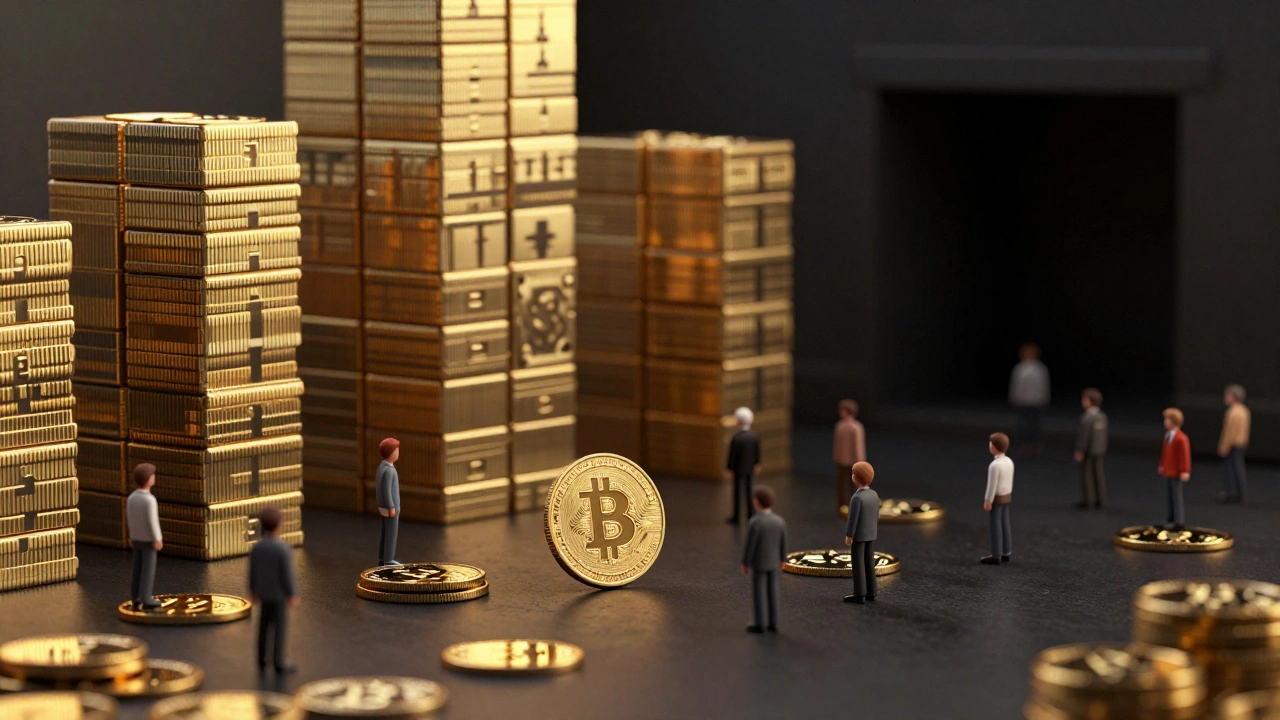
In crypto slang, a 'whale' is someone who holds enough Bitcoin to influence the market price through their buying or selling. Traditionally, this meant holding over 1,000 BTC. However, as the price has risen, the definition has shifted. Now, anyone holding 100 BTC or more is often considered a whale.
Why do whales matter? Because their actions create volatility. If a whale decides to move 500 BTC to an exchange, traders get nervous. They assume a sell-off is coming, which can drive the price down temporarily. Conversely, if a whale moves coins to a cold storage wallet (offline security), it signals confidence, often boosting the price.
However, not all whale movements are malicious. Many are related to internal transfers, security upgrades, or compliance checks. For the average investor, watching whale activity is less about predicting the next day's price and more about understanding market sentiment. Tools like Whale Alert on Twitter provide real-time notifications of large transactions, allowing you to see what the big players are doing without needing to decode the blockchain yourself.
The Rise of Institutional Ownership
A major shift occurred in 2024 with the approval of Spot Bitcoin ETFs in the United States. This allowed traditional financial institutions to buy Bitcoin directly within regulated frameworks. Since then, companies like BlackRock and Fidelity have accumulated hundreds of thousands of coins on behalf of their clients.
This changes the landscape of ownership. Previously, Bitcoin was largely a peer-to-peer asset held by individuals. Now, a significant portion is held by pension funds, endowments, and wealth management firms. This institutionalization adds stability but also centralizes control in the hands of a few large asset managers.
For the individual asking 'how many people own 1 Bitcoin?', the answer now includes indirect owners. You might not have a private key, but if you have a retirement account invested in a Bitcoin ETF, you technically own a fraction of the underlying assets. This broadens the base of Bitcoin ownership beyond just crypto-native users.

How to Check Your Own Status
Curious about your place in the ecosystem? You don't need to be a data scientist to find out. Blockchain explorers like Blockchain.com or Mempool.space allow you to search any public address. If you have your own self-custody wallet, you can plug in your public address to see your balance and transaction history.
Remember, privacy is a double-edged sword. While Bitcoin is pseudonymous, all transactions are public. If you hold one Bitcoin in a personal wallet, that information is visible to anyone who knows your address. This is why many serious investors use techniques like multi-signature wallets or mixing services (where legal) to enhance their privacy.
Also, consider the tax implications. In many jurisdictions, including Australia, moving Bitcoin between your own wallets may not trigger a taxable event, but selling or spending it definitely does. Always keep records of your acquisition dates and costs for capital gains tax purposes.
Future Trends in Distribution
As we move further into 2026, the trend is toward fractionalization and easier access. Lightning Network adoption allows for micro-transactions, meaning you can send satoshis (the smallest unit of Bitcoin) instantly and cheaply. This encourages broader usage beyond just 'store of value' hoarding.
We are also seeing more countries adopting Bitcoin-related regulations that protect retail investors. This reduces the fear factor and encourages more people to dip their toes in, even if they start with just $10 worth of Bitcoin. Over time, this could increase the number of people holding small fractions, while the number of whole-coin holders remains relatively stable or grows slowly due to the halving events reducing new supply.
The bottom line? Owning one Bitcoin is a milestone, but it's not a magic ticket to instant fame or extreme rarity. It places you in the top tier of retail holders, yes, but you are sharing that space with thousands of others. The real power lies not in the number of coins you hold, but in how you secure them, manage your taxes, and stay informed about market dynamics.
Is it better to hold 1 Bitcoin or many small fractions?
From a psychological perspective, holding 1 Bitcoin feels more substantial and may encourage long-term holding ('HODLing'). However, financially, it makes no difference. 1 Bitcoin is mathematically identical to 100 million satoshis. What matters is the total dollar value and your strategy for security and diversification. Some investors prefer Dollar-Cost Averaging (DCA) with small fractions to reduce risk, while others aim for the whole coin as a savings goal.
Can I find out who owns a specific Bitcoin address?
Generally, no. Bitcoin is pseudonymous, not anonymous. You can see the balance and transaction history of any address, but you cannot see the name of the owner unless they have publicly linked their identity to that address (like a company publishing its treasury holdings). Blockchain analysis firms try to cluster addresses to identify entities, but they rarely pinpoint exact individuals without external data.
What happens to the Bitcoin held by Satoshi Nakamoto?
The approximately 1 million Bitcoins mined by Satoshi Nakamoto have never been moved. If they were suddenly sold, it would cause a massive market crash. However, most experts believe these coins are lost forever due to lost private keys or Satoshi's decision to remain inactive. Their existence acts as a dormant supply that is unlikely to enter circulation.